
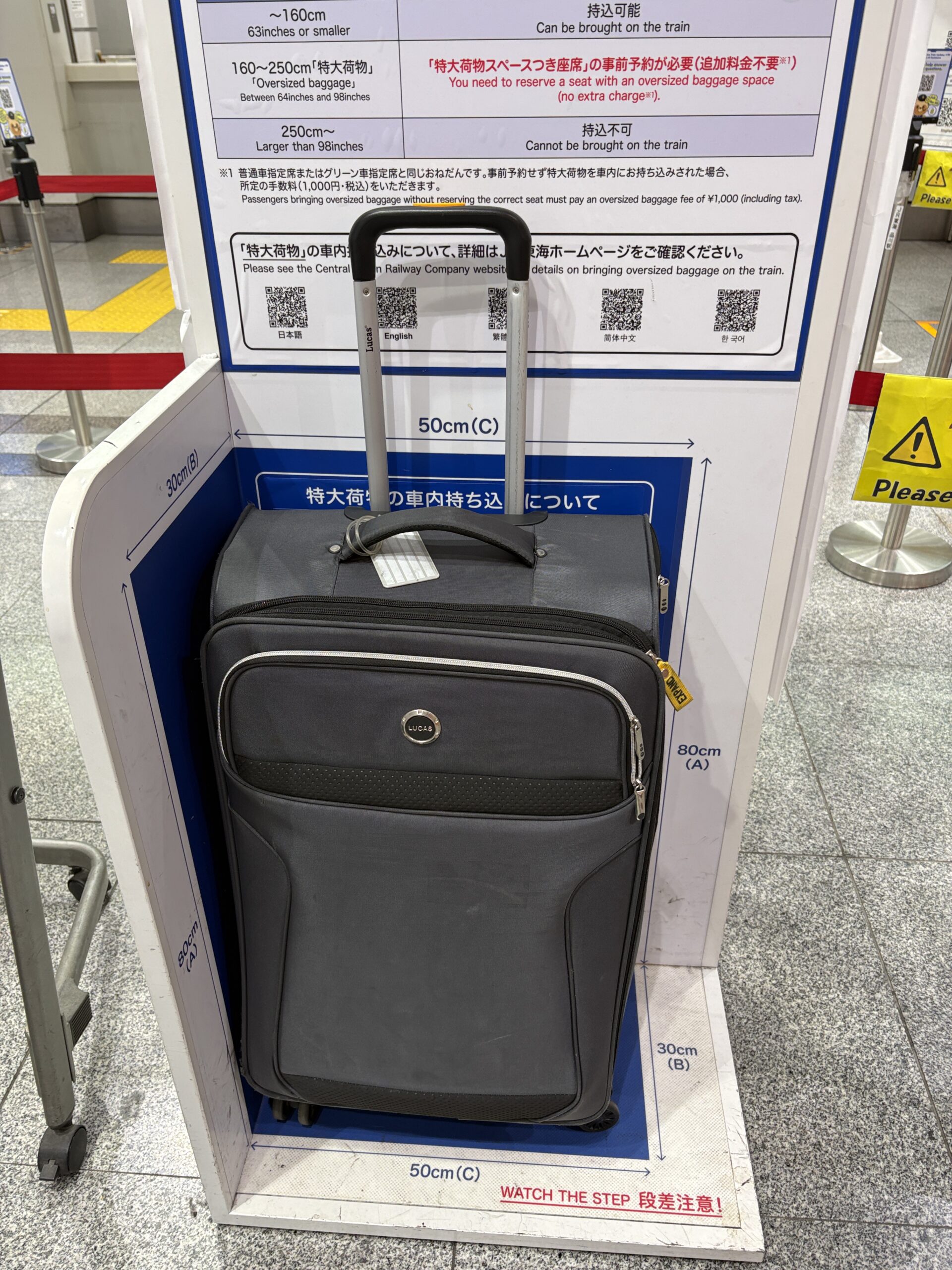
If you are flying into Japan with a big checked suitcase and planning to ride the Shinkansen, there is one rule that trips up first-timers every single week: bags over a certain size need a (free) seat reservation booked in advance. Skip it, and a conductor can charge you ¥1,000 on the spot. After more than twenty years of riding these trains, here is exactly how the Shinkansen luggage rules system works in 2026, how to measure your bag, and the one trick locals use to avoid the whole thing.
Written by Tokyo Becky
The rule: Any bag whose three sides (length + width + height) add up to more than 160 cm needs a reserved “seat with an oversized baggage area.”
Cost to reserve: Free. There is no surcharge if you book the seat in advance, and it is included with a Japan Rail Pass.
The penalty: ¥1,000 (tax included) per unreserved oversized bag, charged onboard, plus your bag gets moved away from you.
Hard limit: Bags over 250 cm total are banned from the train entirely.
Which trains: Tokaido, Sanyo, Kyushu and Nishi-Kyushu Shinkansen (Tokyo to Nagasaki, via Osaka, Hiroshima, Hakata and Kagoshima).
In force since: May 2020.
The easy way out: Forward your big bag ahead with takkyubin for roughly ¥1,500 to ¥2,500 and travel hands-free.
What are the Shinkansen luggage rules in 2026?
Japan’s railways measure your bag by adding together its three dimensions: length plus width plus height. That single number decides everything. There are three tiers, and the whole policy hangs on the 160 cm line.
If your bag totals 160 cm or less, you can simply carry it on and pop it on the overhead rack or at your feet, exactly like you always have. If it totals between 160 cm and 250 cm, it counts as “oversized baggage” and you must reserve a seat with a dedicated luggage space. If it totals more than 250 cm, it is not allowed on the train at all and you will need a delivery service.
| Total size (L + W + H) | In inches | What you need to do |
|---|---|---|
| Up to 160 cm | 63 in or under | Just bring it on. No reservation needed. |
| 160 to 250 cm | 64 to 98 in | Reserve a free “oversized baggage” seat in advance. |
| Over 250 cm | Over 98 in | Not allowed onboard. Use a delivery service. |
For a sense of scale, most standard large checked suitcases (the ones around 28 to 30 inches tall) land right in that 160 cm to 250 cm middle band, which is why so many visitors get caught out. A typical carry-on, on the other hand, is comfortably under 160 cm.
I recently brought a checked suitcase to Japan and took it with me to Nagoya to visit Ghibli Park. Was it worth it? Check out my visit here. Hopefully, the photo I took of my suitcase below will help you gauge whether your suitcase will fit.
Affiliate disclosure: This post may contain affiliate links. If you make a purchase through one of these links, I may earn a commission at no extra cost to you.
The cleanest way to lock in an oversized baggage seat is to reserve your ticket online before you travel, so the luggage space is sorted before you ever reach the platform.
To purchase extra space with your Shinkansen ticket using the link below. First, book a “Reserved seat” ticket. Then, select “Seats with oversized luggage space” at the checkout page.
Please note that only the Tokaido, Sanyo, and Kyushu Shinkansen lines require oversized luggage seat reservations.
Which Shinkansen lines does the oversized baggage rule apply to?
This is the part people miss. The reservation rule only applies to four connected lines that run down the western half of the country:
Tokaido Shinkansen (Tokyo to Shin-Osaka, including Kyoto), the Sanyo Shinkansen (Shin-Osaka to Hakata, including Himeji and Hiroshima), the Kyushu Shinkansen (Hakata to Kagoshima-Chuo), and the Nishi-Kyushu Shinkansen (Takeo-Onsen to Nagasaki). In practical terms, that covers the busiest tourist corridor in Japan: Tokyo, Kyoto, Osaka, Hiroshima and on into Kyushu.
The rule does not apply to the northern and eastern lines such as the Tohoku, Hokkaido, Joetsu and Hokuriku Shinkansen, and it does not apply to ordinary local or limited express trains. On those, you can carry a large bag without a special reservation (though you should still be considerate about where you stow it).
How do I measure my suitcase for the Shinkansen?
Grab a tape measure before you leave home and add the three sides together. Length plus width plus height. That total, not any single side, is what matters. As a real example, a bag measuring 80 cm tall by 50 cm wide by 30 cm deep adds up to exactly 160 cm, which sits right on the threshold.
If you’re really worried, let me reassure you that many of the big stations have a physical measuring frame near the Shinkansen gates, like the bright blue one in the photo at the top of this post, where you can stand your bag inside the box to see instantly whether it is within the limit. If your suitcase fits inside the marked area, you are under 160 cm and good to board with no reservation.
What happens if my bag is too big and I did not reserve a seat?
If you board with an oversized bag (160 to 250 cm total) and have not reserved a seat with a luggage space, a conductor is entitled to charge you a ¥1,000 fee, tax included, per bag. They will then point you to wherever there happens to be free space, which may be in a different car, well away from your seat. It is not the end of the world, but it is an avoidable cost and a stressful start to a journey.
One thing worth knowing: an oversized bag cannot ride on a non-reserved (jiyuseki) ticket at all. The luggage spaces only exist in reserved cars, so if you are traveling with a big suitcase, you need a reserved seat regardless. If you are connecting between trains, reserve the oversized seat for every leg of the trip.
How do I reserve an oversized baggage seat (and does it cost extra)?
It is free. You are not buying anything special, you are just choosing a particular seat. The trick is that the luggage seats are the very back row of each car, with the storage space tucked in directly behind the seatbacks. There are a limited number per train, so they do book up, especially in peak seasons.
You can reserve one of these seats three ways:
At a ticket machine or counter
At any green Shinkansen ticket machine, switch to English, choose your route, and look for the option to select a “seat with oversized baggage area” on the seat map. You can also do it in person at a Midori-no-Madoguchi ticket office, which is the most foolproof option if you are unsure.
Online before you travel
Booking platforms and the official Smart EX service (download the app here) let you tick the oversized baggage seat option as you choose your seat. This is my preferred method because it means the luggage space is settled before I am anywhere near a busy gate.
With a Japan Rail Pass
Pass holders reserve the oversized seat at no extra cost too. Make the reservation at a ticket machine or counter when you activate or use your pass. If the regular cars are sold out of luggage seats, it can be worth checking the Green Car, which has its own oversized spaces.
Where does the luggage actually go on the train?
The oversized space is the gap directly behind the last row of seats in the car. When you reserve a luggage seat, that space is yours. On the N700 and N700S trains used for the fastest Nozomi, Mizuho and Sakura services, you can secure your bag in place using an IC card such as a Suica or Pasmo, which is a nice touch for peace of mind. The one small trade-off is that if there is a bag behind you, the back-row seats will not recline.
Can I just put my suitcase on the overhead rack instead?
For carry-on sized bags, absolutely. The overhead racks on the N700 series are roughly 42 cm deep, which comfortably swallows a cabin bag or a soft holdall. If your bag is under that 160 cm total and you can lift it overhead yourself, the rack is fine and no reservation is involved. The racks are not designed for full-size checked suitcases, though, so do not try to shove a 28-inch hard-shell up there.
What about strollers, skis, golf clubs, and musical instruments?
Good news for families (and sports and music lovers): the oversized baggage rule does not apply to strollers, sports equipment, or musical instruments, even if they surpass the 160 cm limit. You can bring them on as normal. That said, if you specifically want to use the rear luggage space to store them, you can reserve one of the oversized seats for the purpose. Folded strollers usually fit near your feet or in the luggage space without any trouble.
Should I just forward my luggage instead?
Honestly? For a lot of trips, yes. The single best-kept secret of travelling Japan is takkyubin (also called takuhaibin), the country’s famously reliable door-to-door luggage forwarding service. You hand your big suitcase to a counter at the airport, your hotel front desk, or a convenience store, and it arrives at your next hotel, usually the following day. You then ride the Shinkansen with just a small day bag and skip the size rules, the reservation, and the lugging entirely.
I do this almost every time I move between cities. Dragging a heavy suitcase up and down station stairs at Tokyo or Kyoto Station during rush hour is a rite of passage you genuinely do not need.
The last time I sent my bag via takkyubin, it actually arrived three days later, so you might want to plan accordingly. One day later is not always guaranteed.
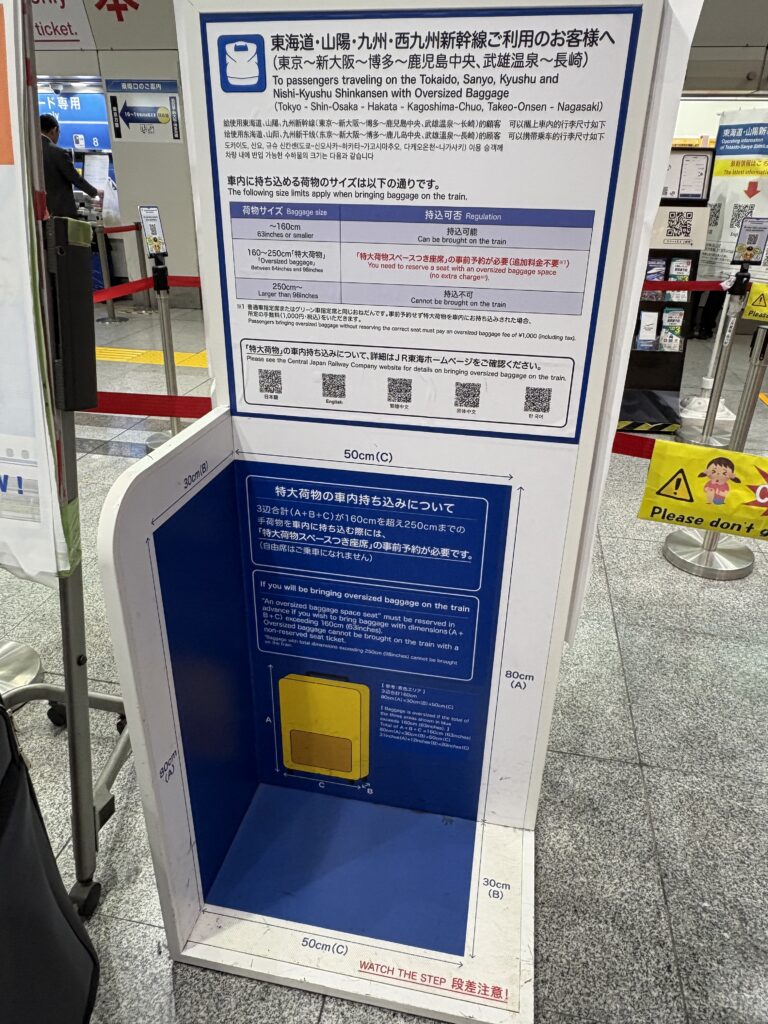
Shinkansen luggage size rules, Photo by Tokyo Becky
| Option | Typical 2026 cost | Best for | Notes |
|---|---|---|---|
| Takkyubin forwarding | ~¥1,500 to ¥2,500 / bag | Hotel-to-hotel or airport-to-hotel moves | Next-day; send a day ahead. More for long-distance routes. |
| Coin lockers | ~¥400 to ¥800 / day | Same-day day trips and short stops | Few are big enough for full-size suitcases. |
| Hotel storage | Free | Before check-in / after check-out | Guests only; ask at the front desk. |
Forward your big bag to your next hotel and ride with just a day pack. It is the stress-free way to do Tokyo to Kyoto to Osaka.
So, is it worth taking big luggage on the Shinkansen in 2026?
Yes, with a little planning it is completely manageable. If your bag is under 160 cm total, you have nothing to think about: carry it on. If it is between 160 cm and 250 cm, reserve the free oversized seat when you book your ticket and you will have no trouble at all. If you are moving between cities with heavy bags, do yourself the favor I wish someone had told me about years ago and forward them with takkyubin. The Shinkansen is one of the great travel experiences on Earth, and it is even better when you are not dragging a suitcase through the crowds.
Frequently Asked Questions: Shinkansen Luggage Rules
What size luggage can I take on the Shinkansen without a reservation?
Any bag whose length, width and height add up to 160 cm (about 63 inches) or less can be carried onto the Shinkansen with no reservation. You stow it on the overhead rack or at your feet. Most standard carry-on suitcases fall under this limit.
How much is the Shinkansen oversized baggage fee?
If you bring a bag over 160 cm total onto the Tokaido, Sanyo, Kyushu or Nishi-Kyushu Shinkansen without reserving an oversized baggage seat, a conductor can charge ¥1,000 (tax included) per bag onboard. Reserving the seat in advance costs nothing extra, so the fee is entirely avoidable.
Which Shinkansen lines require an oversized baggage reservation?
The rule applies to the Tokaido Shinkansen (Tokyo to Shin-Osaka), the Sanyo Shinkansen (Shin-Osaka to Hakata), the Kyushu Shinkansen (Hakata to Kagoshima-Chuo) and the Nishi-Kyushu Shinkansen (Takeo-Onsen to Nagasaki). It does not apply to the Tohoku, Hokkaido, Joetsu or Hokuriku Shinkansen, or to ordinary local and limited express trains.
How do I reserve an oversized baggage seat on the Shinkansen?
Choose a “seat with an oversized baggage area” when you book. You can do this at a green Shinkansen ticket machine, at a Midori-no-Madoguchi counter, or online through services such as Smart EX before you travel. The luggage seats are the back row of each car and there is no extra charge to reserve one.
Can I take a large suitcase on the Shinkansen with a Japan Rail Pass?
Yes. Japan Rail Pass holders can reserve an oversized baggage seat at no extra cost. Make the reservation at a ticket machine or counter when you activate or use your pass. Note that an oversized bag cannot travel on a non-reserved seat, so you always need a reserved seat for it.
What is the maximum luggage size allowed on the Shinkansen?
Bags whose three sides total more than 250 cm (about 98 inches) are banned from the Shinkansen entirely. For anything that large, use a luggage delivery service such as takkyubin to send it to your destination instead.
Do the luggage rules apply to strollers and sports equipment?
No. Strollers, sporting goods like skis and golf clubs, and musical instruments are exempt from the oversized baggage reservation rule, even if they exceed 160 cm. You can still reserve an oversized seat if you want to use the rear storage space for them.
Is it better to forward my luggage than carry it on the Shinkansen?
For most city-to-city trips, forwarding is easier. Takkyubin door-to-door delivery costs roughly ¥1,500 to ¥2,500 per bag, usually arrives the next day, and lets you ride the Shinkansen with just a small bag. It sidesteps the size limits, the seat reservation and the hassle of moving heavy luggage through busy stations.
When did the Shinkansen oversized baggage rule start?
JR introduced the oversized baggage reservation system in May 2020 to manage crowding of luggage space and keep journeys comfortable. It remains in force in 2026 across the Tokaido, Sanyo, Kyushu and Nishi-Kyushu Shinkansen.



0 Comments