
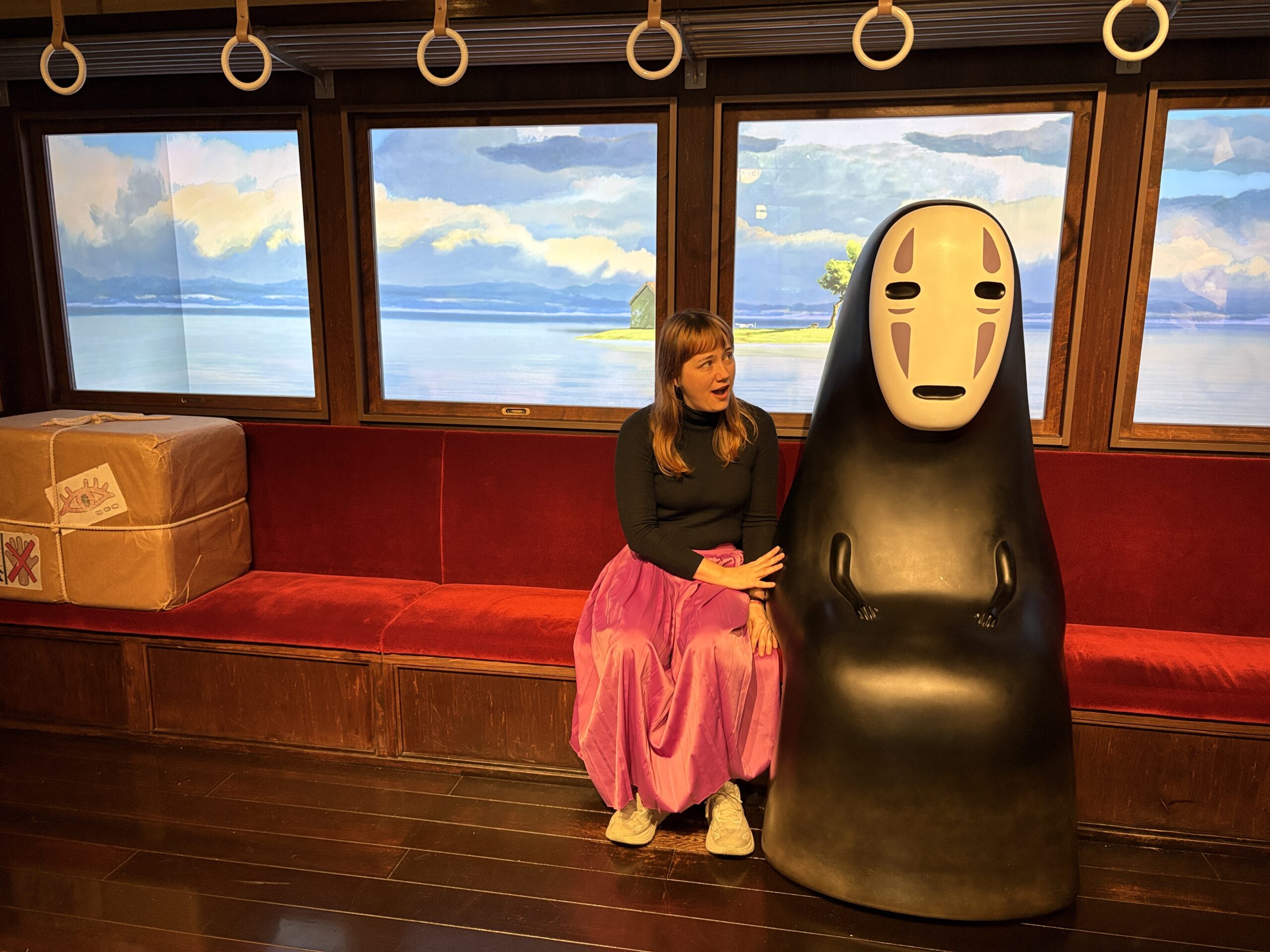
Dear readers, I have some incredible news! After more than two years trying to make it happen, I finally achieved my dream of going to Ghibli Park in Aichi Prefecture near Nagoya, Japan in 2026! Today, I’d like to tell you how I got tickets, my experience at Ghibli Park in Japan, and whether it is worth a visit.
My History with Ghibli
But first – a little backstory. I saw my first Ghibli Studio film when I was 17 years old at the local independent movie theatre in my hometown of Cincinnati, Ohio (shoutout to the Esquire, still in operation today!). That film was Princess Mononoke and I watched a dubbed version with voices by Gillian Anderson, Minnie Driver, Billy Crudup, Claire Danes, and Billy Bob Thornton (do you remember that guy?).
Every since watching my first Hayao Miyazaki film (known as the “Walt Disney” of Japan but with more complex storylines), I have been obsessed and the whimsical side of me eats up anything Ghibli Studio. I can’t get enough! Princess Mononoke was one of the contributing factors that ultimately led me to move to Japan. I was so obsessed that I even visited Yakushima Island, which is said to have been the inspiration for Princess Mononoke’s enchanting forest setting. If you can ever make it to Yakushima, I highly encourage you to do so.
Over the years, I devoured My Neighbor Totoro, Howl’s Moving Castle (the first film I watched entirely in Japanese in Japan!), Ponyo, Kiki’s Delivery Service, Castle in the Sky, and, of course, Spirited Away (my ultimate favorite!).
I went to the Ghibli Museum in Mitaka, Tokyo (1-1-83 Shimorenjaku, within the west part of Inokashira Park, buy tickets in advance here) once in 2005 and wasn’t as impressed as I hoped I would be. At that time, many of my favorite Ghibli films didn’t get a lot of exhibition space at the museum and several exhibitions were older Ghibli films that I didn’t recognize. When I heard that Ghibli Park in Japan had opened on November 2022 at the site of the Expo 2005 Aichi Commemorative Park (Moricoro Park) in Aichi, I knew I had to go as soon as possible.
I tried to get tickets in 2024 but missed the ticket purchasing window. The same thing happened in 2025 and I couldn’t get a ticket that would fit my schedule and also allow me to see as much as the park as I could on one day.
Finally, in 2026, I got my laptop ready, knew exactly the day that I wanted to go (April 15), and logged on at exactly 2pm Japan time to try and buy two premium tickets.
Where Is Ghibli Park in Japan?
Ghibli Park is located in Aichi Prefecture at 1533-1 Ibaragabasama, Nagakute, Aichi 480-1342, Japan. It is about 30 minutes by car from Nagoya or about one hour by train.
How Can You Get Tickets to the Ghibli Park in Japan?
On the 10th of the every month at 2pm Japan Time, you can buy tickets for two months later at the following website if you are buying from overseas. For example, on April 10, you can buy Ghibli Park tickets for June. You can buy from either Lawson or Klook on this site. I tried and they were sold out for the date that I wanted by the time I was allowed access to the site. In the end, I purchased tickets through Lawson with my American credit card.
When I bought a ticket through Lawson, despite logging on right at 2pm Japan time, I still had to wait two hours in on online queue before I could get through to buy tickets. Fortunately, there is an organized system that tells you exactly how many people are in front of you and how many more minutes you had to wait! When I first logged on, the Lawson system said that 10,000 people were in front of me! That’s how popular tickets to Ghibli Park are!
Once I purchased two premium tickets to Ghibli Park, I received an email from ltmail@l-tike.com that had a link to the tickets. The QR code that represented my ticket did not appear until the day of my visit to Ghibli Park. I had to click the link in my email to get my ticket and was warned that I also needed to bring my passport in case a Ghibli Park staff member asked for my identification.
**Please note that Ghibli Park tickets are not valid at Ghibli Museum, Mitaka, and vice versa.
**Please note that you cannot purchase any tickets at any area of Ghibli Park. They must be purchased in advance from the website.
**If you are living in Japan and want to purchase a ticket, please check out this website in Japanese only.
What Type of Tickets Can You Buy for Ghibli Park in Japan?
There are two main day pass options for international visitors: the O-Sanpo Day Pass Premium and the O-Sanpo Day Pass Standard. All tickets are date-specific and must be purchased in advance. There are no walk-ins or same-day sales at the park. Standard pass holders who want to enter certain special buildings in Valley of Witches (Okino Residence, Howl’s Castle, and The House of Witches) can also purchase limited same-day tickets for those buildings on the day of their visit.
How Much Do Tickets to Ghibli Park in Japan Cost?
O-Sanpo Day Pass Premium:
- Adults: 7,300 yen (weekdays) / 7,800 yen (weekends and holidays)
- Children (age 4-12): 3,650 yen / 3,900 yen
- Children under 3: Free
O-Sanpo Day Pass Standard:
- Adults: 3,300 yen (weekdays) / 3,800 yen (weekends and holidays)
- Children (age 4-12): 1,650 yen / 1,900 yen
- Children under 3: Free
Standard pass holders who want to visit the special buildings in Valley of Witches will pay additional fees on the day: Okino Residence (adults 400 yen / children 200 yen), The House of Witches (adults 400 yen / children 200 yen), and Howl’s Castle (adults 1,000 yen / children 500 yen). A service charge is also applied at the time of ticket purchase.
What Is the Difference Between the Standard Ticket and the O-Sanpo Premium Ticket?
The key differences come down to access and price. The Premium pass gives you access to all five park areas: Ghibli’s Grand Warehouse, Hill of Youth, Dondoko Forest, Mononoke Village, and Valley of Witches including all buildings such as Satsuki and Mei’s House, World Emporium, Okino Residence, Howl’s Castle, and The House of Witches with no extra fees for those buildings.
The Standard pass covers only three areas: Ghibli’s Grand Warehouse, Mononoke Village, and Valley of Witches. It does not include entry to the three special Valley of Witches buildings (Okino Residence, Howl’s Castle, and The House of Witches), which require separate same-day tickets if you want to visit them. Re-entry is also more limited on the Standard pass. Only Valley of Witches allows re-entry, whereas Premium holders can re-enter all areas, with Ghibli’s Grand Warehouse re-entry available after 3 p.m.
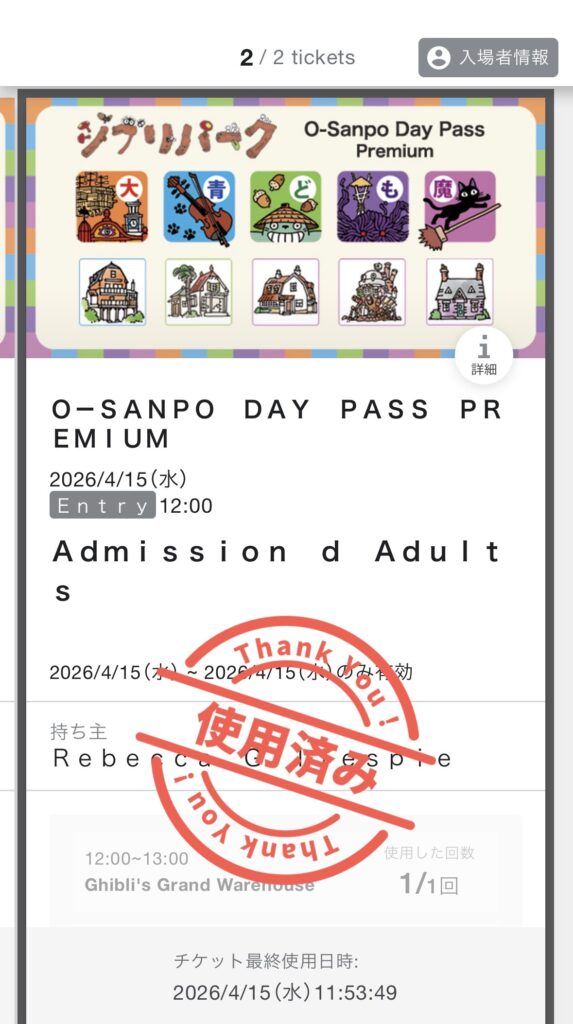
My O-Sanpo Day Pass Premium for the Day, Photo by Tokyo Becky
How Do I Get to Ghibli Park in Japan from Tokyo?
There is no direct train from Tokyo to Ghibli Park, so the journey involves two stages: getting to Nagoya first, and then making your way from Nagoya to the park. The total journey takes around 2.5 to 3.5 hours depending on the route you choose.
Step 1: Tokyo to Nagoya
The fastest and most comfortable option is the Tokaido Shinkansen (bullet train) from Tokyo Station to Nagoya Station. The journey takes approximately 1 hour 40 minutes on the Nozomi service and costs around 10,560 yen for a reserved seat one way. If you have a Japan Rail Pass, the shinkansen leg is covered, though note that the Nozomi is not included on the standard JR Pass. You would need to take the slightly slower Hikari instead, which adds around 20 minutes.
If you are on a tighter budget, overnight highway buses run between Tokyo and Nagoya for as little as around 2,700 to 3,000 yen, but the journey takes 6 to 8 hours, which is only worth considering if you are traveling overnight and want to save on accommodation.
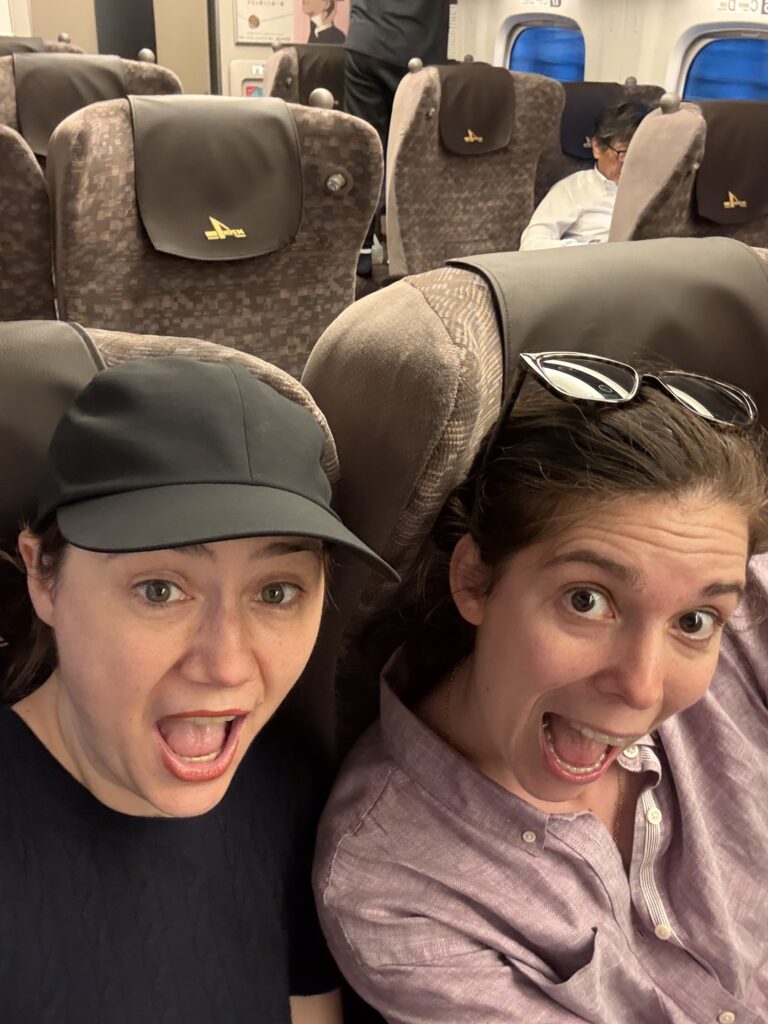
On the way to Nagoya on the Shinkansen from Tokyo with my friend Chiara, Photo by Tokyo Becky
Step 2: Nagoya to Ghibli Park in Japan
Once you arrive at Nagoya Station, there are two main ways to reach the park.
The train is the most popular option. Take the Higashiyama Subway Line (the yellow line) from Nagoya Station all the way to the end of the line at Fujigaoka Station. From there, transfer to the Linimo, which is an elevated maglev train, and ride it to Ai-Chikyuhaku-Kinen-Koen Station. The park entrance is just a short walk from Exit 2 of that station. The total journey from Nagoya Station takes around 46 to 50 minutes and costs approximately 630 to 670 yen. Note that the subway and Linimo portions are not covered by the JR Pass, so you will need an IC card such as Suica or Pasmo, or purchase a separate ticket.
Alternatively, a Meitetsu bus runs directly from the Meitetsu Bus Center on the fourth floor of Nagoya Station to the park, taking around 40 minutes and costing 1,000 yen one way. There are roughly 7 to 10 departures daily, so check the current schedule in advance.
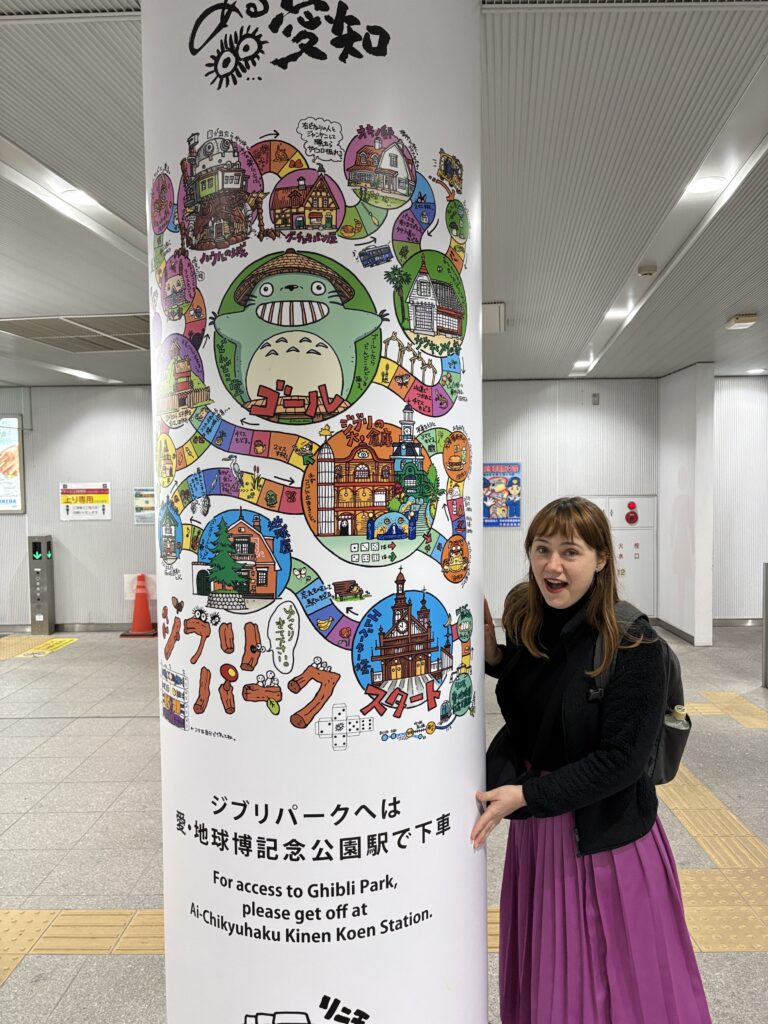
You know you’re getting close to Ghibli Park when…..Photo by Tokyo Becky
Practical Tips
Since the park opens at 10:00 am on weekdays and 9:00 am on weekends, and you want to arrive right at opening to make the most of the day, it is strongly recommended that you stay at least one night in Nagoya the evening before your visit. Trying to do the whole trip from Tokyo and then a full day at the park in one day is possible but exhausting. Nagoya is a great city in its own right, with Nagoya Castle, excellent local food, and plenty to see, so an overnight stop is well worth it.
How Do I Get to Ghibli Park in Japan from Osaka?
Osaka is actually closer to Ghibli Park than Tokyo is, which makes it a more manageable day trip, although staying overnight in Nagoya is still the more relaxing option.
Step 1: Osaka to Nagoya
Take the Tokaido Shinkansen from Shin-Osaka Station (not Osaka Station. You need to get to Shin-Osaka first) to Nagoya Station. The journey takes around 50 minutes on the Nozomi service and costs approximately 6,680 yen for a reserved seat one way. As with the Tokyo route, JR Pass holders should note that the Nozomi is not covered, but the Hikari takes only slightly longer at around 1 hour.
There is also a slower but cheaper option via the Kintetsu limited express train, which runs directly between Osaka-Namba Station and Kintetsu-Nagoya Station in approximately 2 hours and costs around 4,000 to 4,500 yen. This is a comfortable journey that many travelers prefer for the lower price, and the Kintetsu line is not covered by the JR Pass either way, so there is no pass consideration to factor in.
If budget is the priority, there are also direct highway buses running between Osaka (Umeda) and the Aichi Commemorative Park that take around 3 hours 40 minutes to 4 hours, with tickets available from around 2,300 yen. The Willer Express service operates this route several times a week.
Step 2: Nagoya to Ghibli Park in Japan
The route from Nagoya Station to the park is identical to the Tokyo route described above. Take the Higashiyama Subway Line to Fujigaoka Station, transfer to the Linimo, and go to Ai-Chikyuhaku-Kinen-Koen Station. The total time from Nagoya Station is around 46 to 50 minutes and costs around 630 to 670 yen.
One Great Travel Tip
If you are traveling the classic route between Tokyo and Osaka or Kyoto, Nagoya sits directly on the Tokaido Shinkansen line between the two cities. This means a stop at Ghibli Park fits very naturally as a detour in the middle of that journey, without requiring any significant backtracking. Many visitors plan their Ghibli Park visit as a dedicated day in Nagoya on their way between Tokyo and the Kansai region, which is one of the most efficient ways to fit it into a broader Japan itinerary.
What Are the Opening Hours for Ghibli Park in Japan?
The park is open weekdays from 10:00 am to 5:00 pm, and on weekends and holidays from 9:00 am to 5:00 pm. The park is closed on Tuesdays (or the following day if Tuesday is a national holiday), except during school holidays. It also closes for several days over New Year and occasionally for maintenance. Final entry to all areas is at 4:30 pm.
When Did Ghibli Park in Japan Open?
Ghibli Park opened on November 1, 2022, located within the grounds of the Expo 2005 Aichi Commemorative Park in Nagakute, Aichi Prefecture. The park opened in phases: Ghibli’s Grand Warehouse, Hill of Youth, and Dondoko Forest launched first in November 2022; Mononoke Village followed on November 1, 2023; and Valley of Witches opened in March 2024, completing all five areas of the park.
Sidenote: There are no further plans to expand Ghibli Park in Japan at this time.
What Are the Different Parts of Ghibli Park in Japan?
Ghibli Park in Japan is divided into five distinct themed areas, each inspired by different Studio Ghibli films. They are spread across the grounds of the Expo 2005 Aichi Commemorative Park in Nagakute, so visitors should be prepared for quite a bit of walking between them.
1. Ghibli’s Grand Warehouse
This is the largest of the five areas and the only one that is fully indoors, housed in a repurposed exhibition hall. It contains permanent exhibitions, hands-on installations, a vintage-style indoor street, a small cinema that screens exclusive short films, and a large retail and cafe space. This area is the most accessible for all ages and works well regardless of weather. Plan to spend at least 3 hours here as it covers exhibits spanning the full Ghibli catalog.
2. Hill of Youth
Hill of Youth is the first area most visitors encounter when entering the park from the Linimo station. It features the elevator tower seen in “Laputa: Castle in the Sky” and “Howl’s Moving Castle,” as well as a recreation of the antique shop from “Whisper of the Heart.”
3. Dondoko Forest
The main attraction of Dondoko Forest is the full-scale recreation of Satsuki and Mei’s House from “My Neighbor Totoro.” The area also features a large wooden statue of Totoro called Dondoko-do, which is a climbable structure open to children only. A walking trail winds through the surrounding forest.
I sadly did not get a chance to see this part of Ghibli Park during my visit and will have to visit on my next visit.
4. Mononoke Village
Inspired by “Princess Mononoke,” this area recreates the atmosphere of a traditional Japanese mountain village. Visitors can make Gohei Mochi (skewered rice cakes covered in sweet miso sauce) at the Tatara-ba workshop, and the area also features large sculptures of the Tatari-gami demon spirit and the Okkoto-nushi boar god, whose back doubles as a slide for kids. Note that the Okkoto slide is limited to children 12 and under and may close in rainy weather.
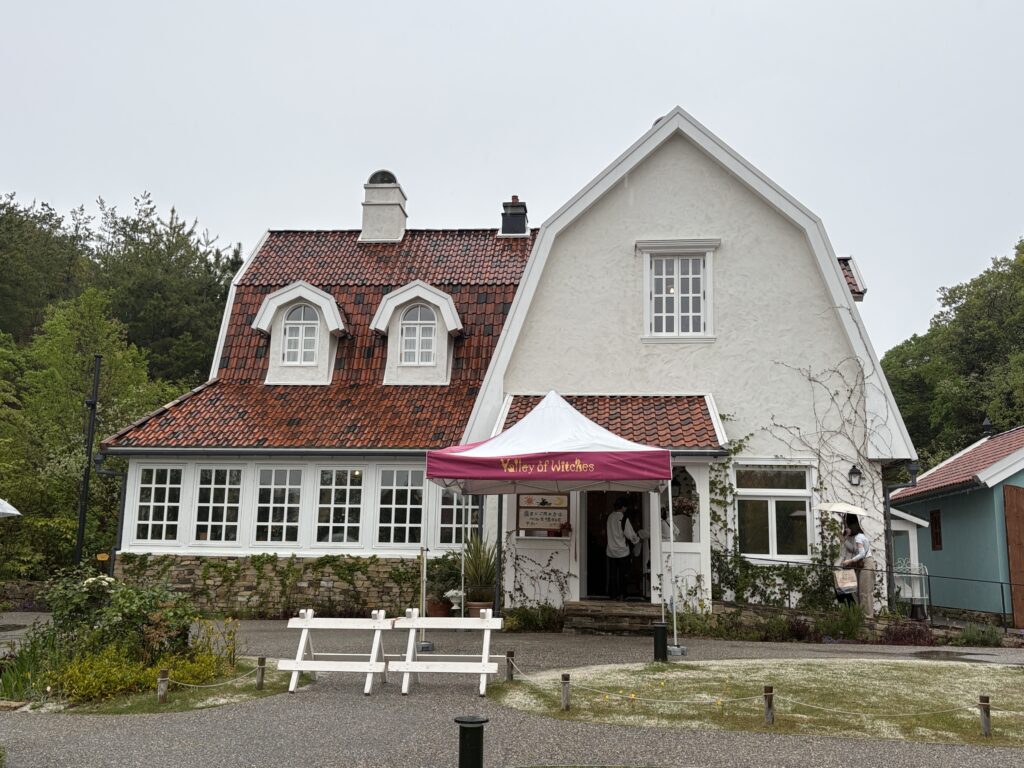
The outside of Kiki’s family home in the Valley Witches (this was one of my favorites!), Photo by Tokyo Becky
5. Valley of Witches
The newest and largest area of the park, Valley of Witches opened in March 2024. It is built around a cobblestoned Western European village and draws from several witch-themed Ghibli films, including “Kiki’s Delivery Service,” “Howl’s Moving Castle,” and “Earwig and the Witch.” Highlights include a working bakery inspired by Kiki’s family shop, the Okino Residence where Kiki stayed before beginning her training, and a life-sized replica of Howl’s Moving Castle standing around 20 meters tall. There are also two small rides for younger children. This area is particularly popular with adult visitors and is considered a half-day destination on its own.
It is worth noting that three buildings within Valley of Witches — Okino Residence, Howl’s Castle, and The House of Witches — require additional same-day tickets for Standard pass holders. Premium pass holders can enter all buildings without any extra fees.
What Are the Best Things to Do at Ghibli Park in Japan?
The Grand Warehouse is by the far the best followed by the Valley of Witches where you can walk through Howl’s Moving Castle and Kiki’s house from Kiki’s Delivery Service. This is also where you can get a drink and a pastry from the bakery featured in Kiki’s Delivery Service and even see the room above the bakery where Kiki and Jiji hang out. The Valley of Witches also features the best restaurant in the park and the only two rides: the carousel and a small flying ride (which was closed due to the rain on the day I visited).
There are two other houses well worth a visit: Whisper of the Heart and the incredibly whimsical (this was my second favorite house after Howl’s Moving Castle).
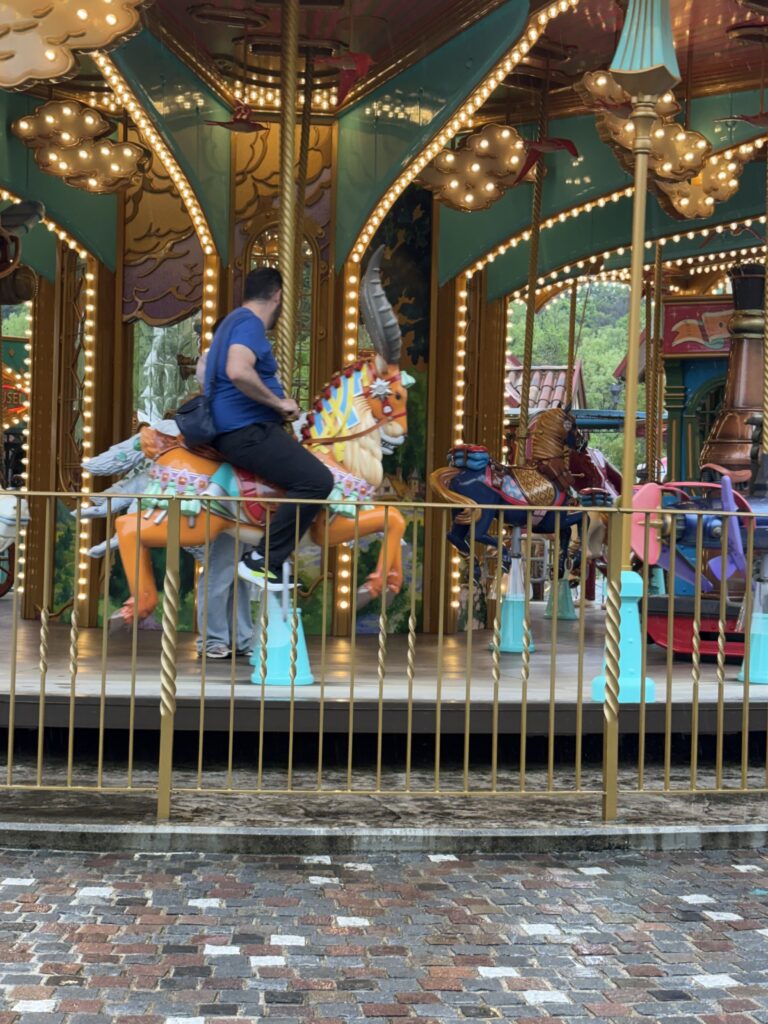
The carousel at the Valley of Witches (it costs 500 yen to ride), Photo by Tokyo Becky
When Can I Enter the Grand Warehouse at Ghibli Park in Japan?
The Grand Warehouse is the only part of Ghibli Park that requires a timed entry, and your entry slot is fixed at the time you buy your ticket. Available entry times are 9 a.m. (on days when the park opens at 9:00 am), 10:00 am, 11:00 am, 12:00 pm, 1:00 pm, and 2:00 pm. You must enter no later than one hour after your reserved time, and early entry is not allowed. Getting an earlier slot is generally recommended, as it gives you more time to explore. The Warehouse typically takes at least 3 hours to see properly. Note that once you leave, you cannot re-enter the Grand Warehouse until after 3 p.m., so plan your visit accordingly.
I ended up getting a 12:00 pm entry to the Grand Warehouse, and I discovered that the staff are very serious about not letting people in until exactly your ticket entry time.
Cinema Orion
Inside the Grand Warehouse is Cinema Orion, a small screening room that seats approximately 170 people. It screens a rotating selection of 10 original Studio Ghibli short animated films that were previously only available to watch at the Ghibli Museum in Mitaka, Tokyo. The shorts rotate on a monthly schedule, so what is screening will depend on when you visit. Photography and recording inside the theater are not permitted. The films are shown in Japanese, so non-Japanese speakers may want to familiarize themselves with the stories beforehand.
The day that I went to Ghibli Park, I had the opportunity to see the 14-minute short film from 2018 called Boro the Caterpillar. It took me a few minutes to get into it, but I sat mesmerized watching Ghibli on the big screen.
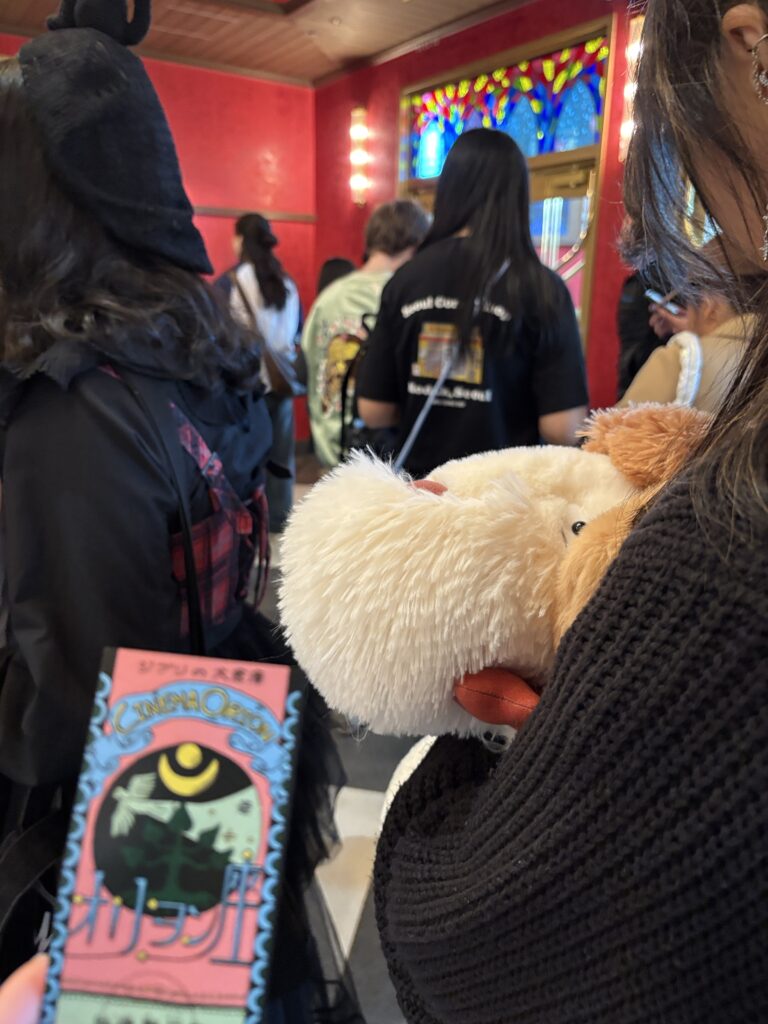
My beautiful ticket to the cinema at Ghibli Park next to Heen, the most popular stuffed animal available at Ghibli Park. People stand in line as soon as the park opens and race to the shop where you can buy many versions of Heen, Photo by Tokyo Becky
The Food Exhibition
The Grand Warehouse has hosted a highly popular special exhibition called “Delicious! Animating Memorable Meals,” which explores why the food in Studio Ghibli films looks so incredibly appetizing. The exhibition features concept art, original animation cells, storyboards, and behind-the-scenes materials showing how the animators create those irresistible food scenes. It also includes life-size three-dimensional replicas of iconic kitchens and food stalls from the films, including the food stall from “Spirited Away,” the kitchen from “Castle in the Sky,” and the breakfast scenes from “Howl’s Moving Castle.” Note that as of mid-2026, this particular exhibition is scheduled to end on June 8th, and the space will be remodeled, so check the official Ghibli Park website for the latest exhibition information before your visit.
The Yubaba Room
One of the most talked-about spots in the Grand Warehouse is the Director’s Room, home to Yubaba, the bathhouse boss from “Spirited Away.” You cannot enter the room itself, but you can peer in from the doorway or through the window to see a beautifully detailed diorama recreation of Yubaba at her desk, surrounded by floating contract papers, her three green Kashira companions at her feet, and various details from the film. It makes for a great photo opportunity.
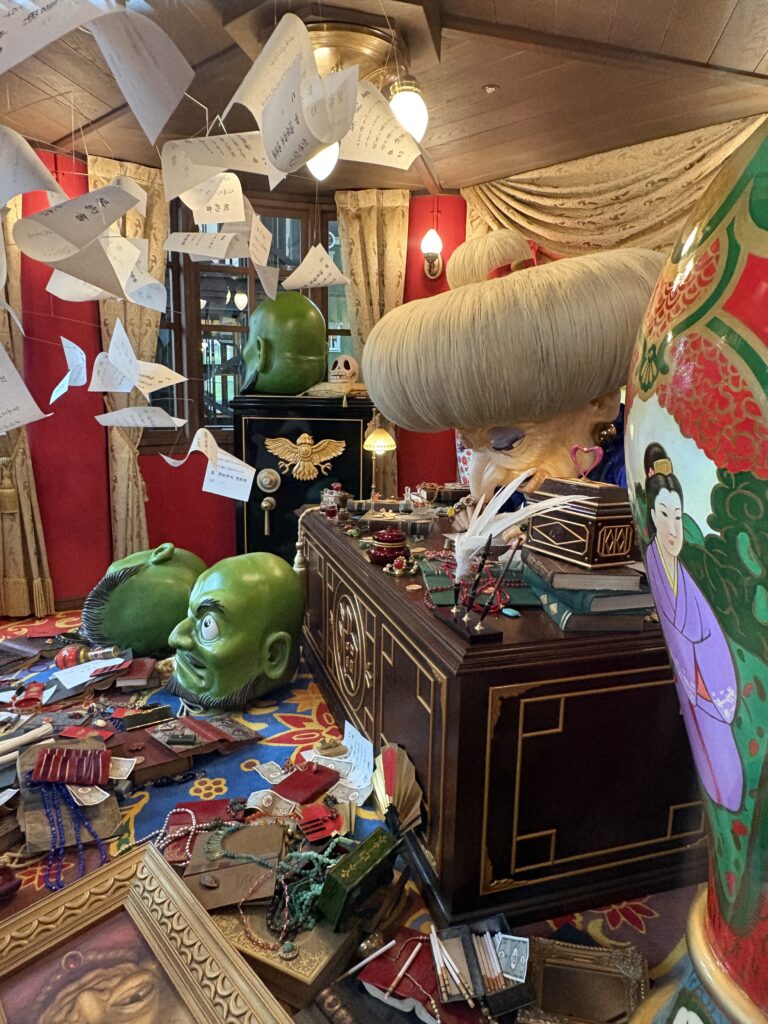
Yubaba’s Room at the Grand Warehouse, Photo by Tokyo Becky
Photo Opportunities with Ghibli Characters
One of the biggest draws in the Grand Warehouse is the “Becoming Characters in Memorable Ghibli Scenes” exhibition, where you can step into life-size recreations of famous scenes from across the Ghibli catalog. There are 14 scenes in total, featuring characters and settings from films including “Spirited Away,” “Kiki’s Delivery Service,” “Ponyo,” “Porco Rosso,” “Pom Poko,” and “The Wind Rises,” among others. The most popular by far is the scene where you can sit on the mysterious sea railway train next to No-Face from “Spirited Away.” Expect a significant wait for this one, particularly on weekends and in the afternoon. Many visitors recommend joining this line first thing after entering, or returning in the morning if the queue looks long. Photography is welcomed throughout this exhibition, which sets it apart from the Ghibli Museum in Tokyo where cameras are prohibited.
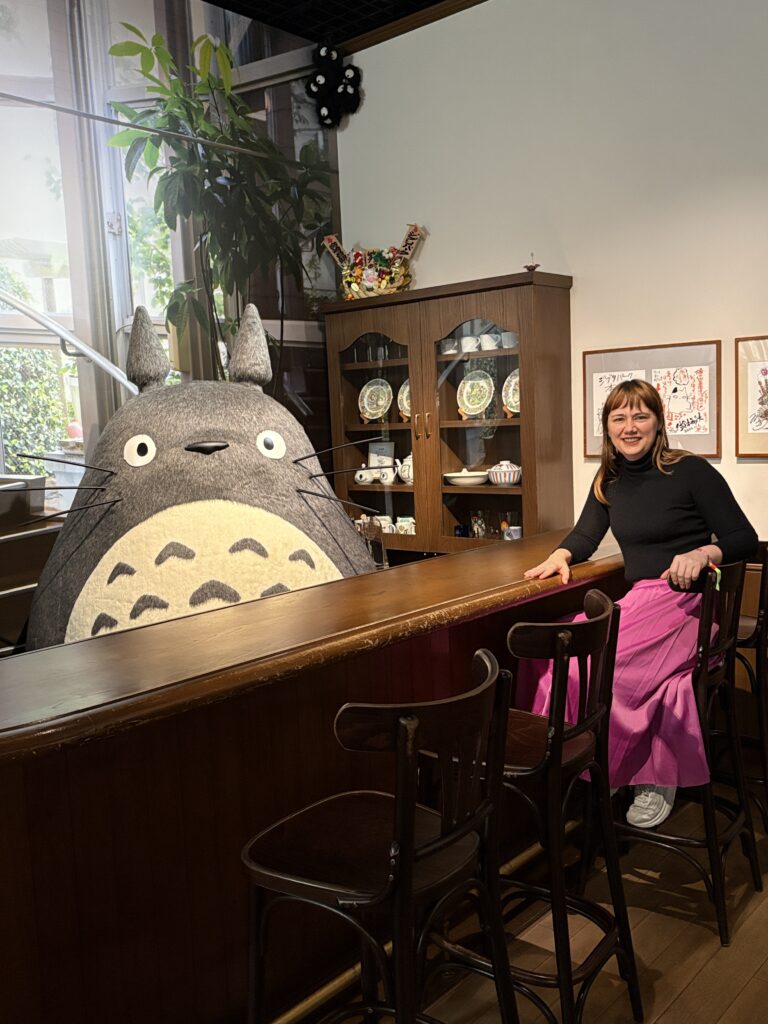
Getting to meet Totoro in the Grand Warehouse, Photo by Tokyo Becky
Where Can I Eat at Ghibli Park in Japan?
There are several dining options spread across different areas of the park, each with its own Ghibli-themed personality.
Inside Ghibli’s Grand Warehouse, the main restaurant is the Transcontinental Flight Cafe, which serves sandwiches, square-style pizzas, and lighter dishes designed to be eaten with one hand (a nod to the long-distance pilots of films like “Porco Rosso”). It is open weekdays from 11:00 am and from 10:30 am on weekends and holidays. Also inside the Grand Warehouse is Milk Stand Siberi-An, a small counter selling bottled local milk and “Siberia” cake, a traditional Japanese sweet made of castella sponge cake layered with sweet red bean paste, inspired by the treat seen in “The Wind Rises.”
In the Valley of Witches, the Flying OVEN is a full-service sit-down restaurant with a brick exterior, located near Tsutsuji Pond. It serves European-style baked dishes including pies and quiches, plus themed desserts and a selection of Valley of Witches branded beers and wines. There is also a rooftop garden. The Guchokipanya Bakery, inspired by Kiki’s family bakery in “Kiki’s Delivery Service,” sells freshly baked breads and pastries, and the Hot Tin Roof is an outdoor food stand serving hot dogs in cat paw-shaped buns and other snacks.
At Mononoke Village, visitors can make their own Gohei Mochi, traditional skewered rice cakes coated in sweet miso sauce, over a charcoal grill at Tatara-ba for an additional fee.
There is also a cafe called Rotanda Kazegaoka near the park’s north entrance that is accessible without a Ghibli Park ticket. It offers Japanese-style sweets, matcha parfaits, and light meals including onigiri rice balls.
One important rule: you may only eat food purchased inside the park while within the paid areas. Bringing in outside food is not permitted inside any of the five Ghibli zones.
Are There Any Rides at Ghibli Park in Japan?
Ghibli Park is not a traditional thrill-ride park and has very few rides overall. There are two official rides, and both are located in Valley of Witches.
The Carousel is a merry-go-round where instead of traditional horses, riders sit on beloved Ghibli characters and vehicles, including the Catbus from “My Neighbor Totoro.” It is described as a traveling fairground ride that visits the village once a year. Tickets cost 1,000 for adults and 500 yen for children per ride, and it is available to children aged 3 to 12, with one accompanying adult allowed to ride alongside a child.
The Flying Machine is an aerial carousel-style ride inspired by the flying vehicles of “Castle in the Sky,” where riders spin and rise through the air in Ghibli-themed aircraft. It is also priced at 500 yen per ride and subject to the same age guidelines. Both rides may close in rainy weather.
Both rides require a separate ticket purchase on top of your park admission, regardless of which pass you hold.
What Makes Ghibli Park in Japan Different from Other Theme Parks?
Unlike every other theme park you’ve been to, Ghibli Park in Japan doesn’t have an official entrance or main gates preventing you from entering. Instead, each separate area has people checking your tickets and scanning your QR code. This means that you can walk right into Ghibli Park and walk along right along the edge of each of the different areas without even having a ticket! So, if you are a huge Ghibli fan and couldn’t get tickets, you can still walk around the park, but you will not be able to go into restaurants or any of the themed houses or areas, only the green area around it.
As we also mentioned, Ghibli Park only has two rides. Instead, you can enter different houses and feel like you are stepping into parts of the different Ghibli movies. Once you enter these houses, the experience is designed to be genuinely interactive in a way that most theme parks never attempt. You are not just walking through a velvet-rope corridor glancing at displays behind glass. You are encouraged to open drawers, peer into bags left on the floor, look through windows, and poke around every corner of each room. The houses are built with the assumption that curious visitors will touch, explore, and investigate, and the reward for doing so is finding the kind of tiny, obsessive details that Studio Ghibli is famous for. A half-eaten meal left on a table. A piece of paper tucked into a desk drawer. A view through a small window that reveals something unexpected outside. The whole philosophy of the park is that the magic is in the details, and you only find those details if you are willing to slow down and look.
This approach reflects something Hayao Miyazaki has always believed: that the world of a story should feel lived-in and real, not like a stage set. At Ghibli Park, the houses are the attraction and not just the backdrops.

At Ghibli Park, it’s the little things you find along the way that excite you, not the next roller coaster (Ghibli Park doesn’t have any), Photo by Tokyo Becky
What Is the Difference Between the Ghibli Museum in Mitaka and Ghibli Park in Aichi Prefecture?
Both the Ghibli Museum and Ghibli Park are official Studio Ghibli destinations in Japan, and both require advance ticket reservations that sell out fast. Beyond that, they are quite different experiences and serve different kinds of visitors.
The Ghibli Museum opened in 2001 in Mitaka, a quiet suburban area on the western edge of Tokyo. Hayao Miyazaki himself designed the building, and his personal philosophy is stamped on every corner of it. Its guiding motto is “Let’s Get Lost Together,” and the museum is intentionally designed with no clear paths or signposting, encouraging visitors to wander, discover, and stumble across things unexpectedly. It is a compact, mostly indoor space spread across three floors, and most visitors spend around 2 to 3 hours there. The focus is on the art and craft of animation: you will find exhibitions on storyboarding, hand-drawn animation techniques, early sketches, and the creative history of the studio. There is a small theater called the Saturn Theater that screens exclusive short films, and a rooftop garden featuring a large robot soldier from “Castle in the Sky.” One very important rule: photography is strictly prohibited inside the museum. Miyazaki made this decision deliberately, so that visitors would experience the space through their own eyes rather than through a screen.
The Ghibli Museum is easy to reach from central Tokyo, taking around 20 to 25 minutes on the JR Chuo Line from Shinjuku to Mitaka Station, followed by a short walk or a dedicated Ghibli-themed community bus. It fits comfortably into a half-day and can be combined with a walk around the nearby Inokashira Park.
Ghibli Park, on the other hand, is a full-day commitment located near Nagoya in Aichi Prefecture, around 3 hours from Tokyo by shinkansen. It is enormous by comparison, spread across five themed areas within the grounds of the Expo 2005 Aichi Commemorative Park. Where the museum is about understanding how the films were made, Ghibli Park is about stepping inside the worlds the films created. You walk through life-sized recreations of the houses, villages, and landscapes from the movies. Photography is actively encouraged throughout most of the park, and the experience is hands-on and physically immersive in a way the museum is not. You will spend a full day there and may still feel like you have not seen everything.
In short: the Ghibli Museum is intimate, artistic, and cerebral, and works perfectly as part of a Tokyo itinerary. Ghibli Park is expansive, physical, and immersive, and deserves its own dedicated day. If your travel route takes you between Tokyo and Kyoto or Osaka, stopping in Nagoya for Ghibli Park fits very naturally along the way. If you can only do one, the answer really comes down to whether you want to understand the magic or live inside it.
Final Verdict: Is Ghibli Park in Japan Worth Visiting?
If you are a Studio Ghibli fan, even a casual one, the answer is yes. Ghibli Park is unlike anything else you will find in a theme park anywhere in the world. It does not try to compete with Disneyland or Universal Studios, and it does not need to. Its entire philosophy is built around something rarer and harder to manufacture than a roller coaster: the feeling of genuinely inhabiting a world you love.
That said, it is worth going in with realistic expectations. This is not a park that will thrill you with rides or dazzle you with parades. The two rides that exist are gentle and designed for young children. What the park offers instead is atmosphere, detail, and the quiet joy of opening a drawer in Kiki’s house and finding exactly what you hoped would be there. For the right kind of visitor, that is worth more than any ride.
The logistics do take some planning. Tickets sell out fast, often within minutes of going on sale on the 10th of each month. The park is not the easiest place to get to if your trip is centered on Tokyo, and you should budget for a full day plus at least one night in Nagoya. The Premium pass is expensive but worth it if you want access to everything, since the special buildings in Valley of Witches alone justify the price difference over the Standard pass.
The park is excellent for families, for couples, and for solo travelers who are happy to take their time. It is perhaps less suited to visitors who have never seen a Studio Ghibli film and have no particular connection to the characters or worlds, though the sheer beauty and craftsmanship of the spaces is impressive regardless.
If you are going to Japan and you love Studio Ghibli even a little, do whatever it takes to get tickets. Few places in the world reward curiosity, slowness, and attention to detail the way Ghibli Park does. Walk slowly, open the drawers, peer through the windows, and resist the urge to rush. The magic is there just behind the doors or at the other end of a staircase.
Finally, this goes without saying: if you haven’t seen a Studio Ghibli film before, I would recommend My Neighbor Totoro first followed by Spirited Away, Kiki’s Delivery Service, and Princess Mononoke. There are many more to watch, but this should be your starter pack. Enjoy!
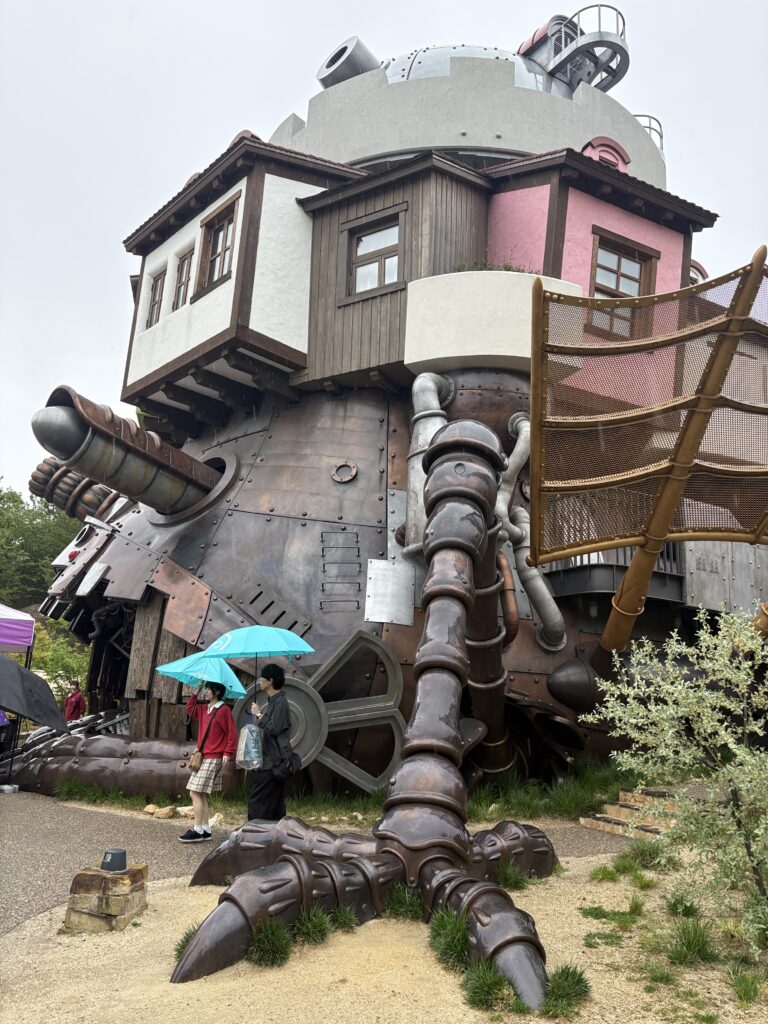
Getting ready to step inside Howl’s Moving Castle (you cannot take photos inside, but, trust me, it is incredibly impressive) in the Valley of Witches, Photo by Tokyo Becky
Didn’t buy a ticket in advance but still want to go to Ghibli Park?
Book this tour that comes with a standard ticket!
Want to explore more of Nagoya? Check out these tours!
Highlights of Nagoya guided by a friendly local
Gujo, Hida Takayama, and Shirakawa-go day tour from Nagoya
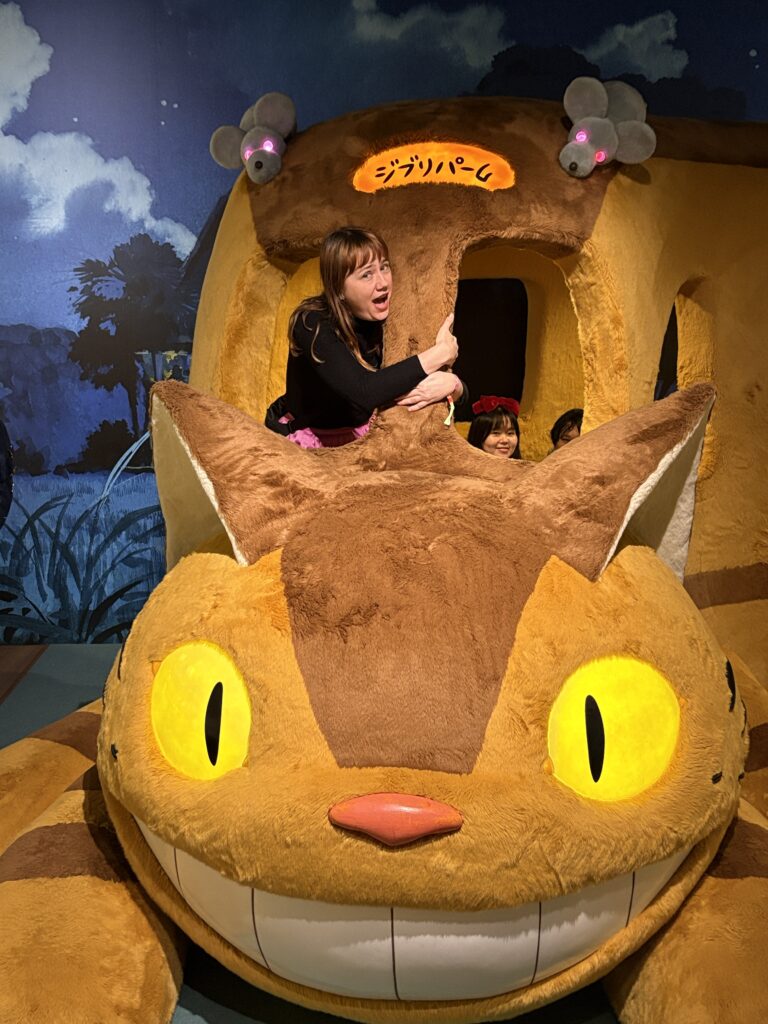
Finally getting to spend time inside the Cat Bus from Totoro, Photo by Tokyo Becky



0 Comments