

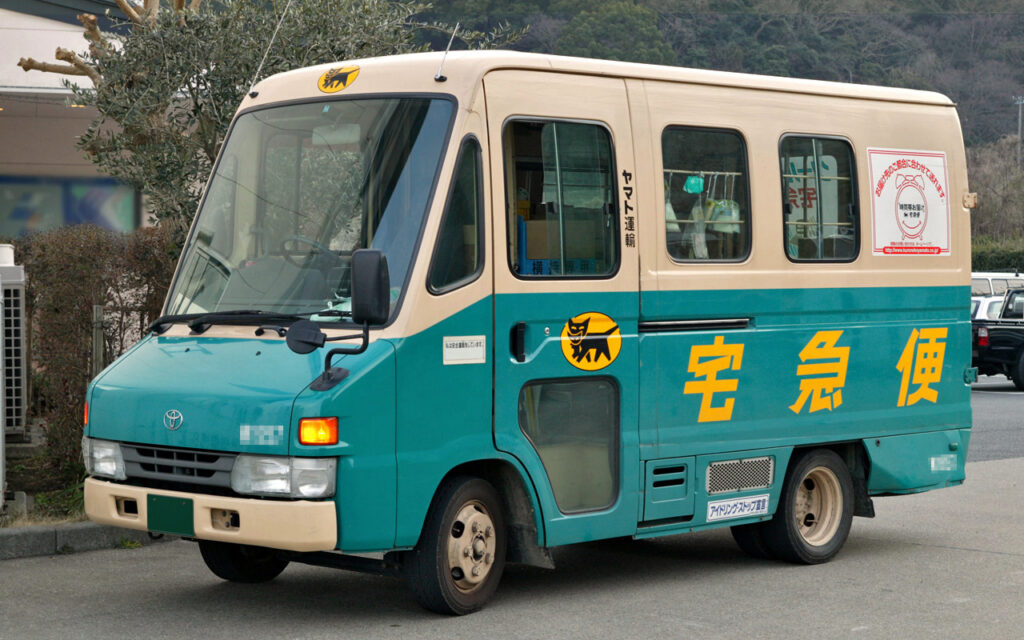
Dragging a 26-inch suitcase through Shibuya Station at rush hour is one of the fastest ways to regret packing that extra pair of shoes. Japan solved this problem decades before “hands-free travel” became a marketing phrase: mail your luggage in Japan through a nationwide courier network called takkyubin, run mostly by Kuroneko Yamato (the black cat company), and it will meet you at your next hotel, usually by the following day.
Last updated: September 2026 by Tokyo Becky
Service: Kuroneko Yamato TA-Q-BIN (takkyubin), Japan’s main door-to-door courier
Typical cost: ¥1,500–¥3,700 per suitcase depending on size and distance
Delivery time: Usually next-day between cities; 2–3 days to Hokkaido or Okinawa
Drop-off points: Hotel front desks, Yamato counters, 7-Eleven, FamilyMart, NewDays
Online booking in English: The Bounce app/website (runs on Yamato’s network)
Airport counters: Narita, Haneda, Kansai, and Chubu (plus a ¥660 counter fee)
Size limit: 200 cm combined length + width + height, 30 kg maximum
Compensation if lost or damaged: Up to ¥300,000 per item
What Is Takkyubin, and Why Does Everyone in Japan Use It?
“Takkyubin” is just the generic Japanese word for door-to-door courier delivery, the same way “Kleenex” gets used for tissue. The company behind most of it is Yamato Transport, nicknamed Kuroneko (black cat) after its logo, and its specific product is branded TA-Q-BIN. This isn’t a tourist gimmick. It’s the same network Japanese families use to send home a box of mikan from grandma’s, or that ski resorts use to get your board back to the station, which is exactly why it works so well to help mail luggage in Japan for visitors: convenience stores, ryokan, hotels, and airports already double as drop-off points, with English-language waybills standard at major counters. Instead of hauling a suitcase up station stairs onto a packed Shinkansen platform, hand it over the evening before you travel and pick it up, luggage-free, at your new hotel the next day.
I have used takkyubin multiple times while both living in and visiting Japan when I wanted to send my snowboard to my ski resort in Japan instead of carrying it or even send a big suitcase from one hotel to another on opposite ends of Tokyo. This is really a very useful service when the cost of taxis can be so high in Japan and taking your luggage into the subway feels physically impossible. I would just allow one more day than you think it might take to arrive to the next destination (just in case).
This post contains affiliate links. If you book or purchase through them, I may earn a small commission at no extra cost to you.
How Much Does It Cost to Mail Luggage in Japan in 2026?
Yamato prices by a size band not weight alone. The “size” is the sum of your bag’s length, width, and height in centimeters, and pricing climbs with both the size band and the distance the parcel travels. A route that crosses regions (Tokyo to Osaka, or anywhere to Hokkaido or Okinawa) typically adds ¥100–¥600 to the same-region price below.
| Size Band | Typical Bag | Same-Region Price (2026) | Notes |
|---|---|---|---|
| 100 | Small carry-on | ~¥1,530–1,650 | Max 10 kg |
| 120 | Standard checked bag, 26 in | ~¥1,970–2,040 | Max 15 kg |
| 140 | Large checked bag, 28 in | ~¥2,310–2,630 | Max 20 kg |
| 160 | Extra-large suitcase or ski bag | ~¥2,630–3,700 | Max 25–30 kg |
Measure your bag before you assume the cheap fare: a suitcase that “looks medium” is often 135–145 cm across all three sides, which puts it in the 140 band, not the 120 one. Budget two extras: Narita and Haneda airport counters add a ¥660 usage fee, and same-day service (a handful of short routes only) roughly doubles the cost of next-day delivery. For an exact quote, use Yamato’s official English rate calculator. Please confirm the current rates before you travel.
Want a fixed English booking flow instead of filling out a paper waybill at the convenience store? Bounce runs on Yamato’s own delivery network but lets you pick your drop-off point, pay, and get a QR code entirely online, from ¥2,090.
How Do I Send My Luggage from the Airport to My Hotel?
Landing at Narita or Haneda jet-lagged with a full suitcase is exactly the scenario takkyubin was built for. Instead of wrestling your bag onto the Narita Express or an Airport Limousine Bus, you can send it straight to your hotel and ride in with nothing but a daypack.
- Clear customs and collect your bags from the carousel as normal. Don’t re-check anything with the airline first, this happens after you exit.
- Find the Yamato TA-Q-BIN counter in the arrivals hall. Narita has counters at Terminal 1 and Terminal 2; Haneda has them at Terminals 1, 2, and 3; Kansai and Chubu also have counters near arrivals.
- Pick up a bilingual waybill and fill in your hotel’s name, full address, and phone number as the destination.
- Choose a delivery date. Next-day is standard; same-day airport-to-hotel isn’t the default option at a regular Yamato counter.
- Pay at the counter (cash or card). A ¥660 counter usage fee is added automatically on top of the normal delivery rate.
- Keep your tracking slip and let your hotel know roughly when to expect the bag at reception.
Budget around ¥3,000–¥3,700 for a large checked bag from a Tokyo airport to a central Tokyo hotel, including the surcharge. If you land after about 8:00 p.m., the next-day delivery window can close for the day, so ask the counter staff whether you need to book two days out instead. A useful workaround: rather than shipping the bag the moment you land, hold onto it for your first night and send it the evening before your first intercity Shinkansen leg, so there’s no timing pressure at all.
If you specifically want your bag the same day, JAL ABC’s Hands-Free Travel counters at Haneda (T3), Narita (T1/T2), Kansai (T1), and Chubu offer same-day airport-to-hotel delivery for a flat rate of about ¥4,500 per suitcase, regardless of size, with arrival by evening if you check in by early afternoon. It costs more than standard TA-Q-BIN, but it skips the overnight wait entirely. The reverse trip works too: most hotels and JAL ABC counters will send a bag from your hotel back to the airport a day or two ahead of a departing flight, so you can check in without carrying it through security.
Sort of, with a catch. Yamato’s official English portal at kuronekoyamato.co.jp has an English rate calculator and tracking tool, but standard TA-Q-BIN isn’t built for travelers to reserve a pickup entirely online the way you’d book a hotel. In practice, you hand your bag over in person, at a hotel front desk, airport counter, or convenience store, and fill in a bilingual paper waybill on the spot. It’s quick (under ten minutes), but not a book-ahead-and-forget system.
To mail luggage in Japan with a fully online English booking flow is where Bounce comes in. It partners directly with Yamato, so your bag still moves through Yamato’s network, but you choose your pickup and delivery location on the website or app, pay upfront, and get a QR code and tracking link with no Japanese needed anywhere in the process. It’s the closest thing to a true “sign up online” option for mailing luggage in Japan, and hotel-to-hotel delivery is included.
Can I Send My Luggage from a Convenience Store in Japan?
Yes, and it’s the option to remember if your hotel doesn’t offer front-desk pickup or you’re staying in an Airbnb. (When you’re booking your next stop, it’s worth checking that it does, most mid-range and above hotels in Japan booked through Booking.com handle takkyubin drop-off and pickup as a matter of course.) Any 7-Eleven, FamilyMart, Lawson, NewDays (inside JR stations), Daily Yamazaki, or Poplar location nationwide will accept a Yamato parcel:
- Walk in and look near the register or the magazine racks for a rack of shipping waybills (they’re bilingual). If you can’t find it, use Google Translate or ChatGPT to ask the person behind the counter.
- Fill in your next hotel’s name, address, and phone number as the destination, and your own contact details as the sender. Having your hotel’s booking confirmation on your phone makes this painless.
- Choose your delivery date, usually the next day, and hand the completed slip and your bag to the cashier.
- Pay in cash (most locations don’t take card for this specific service) and keep the tracking stub they hand back.
The whole thing takes about ten minutes. One catch: not every store accepts extra-large bags (size 160+), since counter space is limited. For a genuinely oversized suitcase, head to a Yamato service office instead, or ask your hotel to arrange the pickup.
What Other Services Can Forward Luggage in Japan?
Kuroneko Yamato is the default for most visitors, but it isn’t the only option. Here are other options to mail luggage in Japan:
- Sagawa Express – Occasionally a little cheaper on regional routes, drops off at FamilyMart and Lawson, but has fewer English-language resources than Yamato.
- JAL ABC – Airport specialists with counters at Narita, Haneda, and Kansai. Best known for same-day airport-to-hotel delivery in the Tokyo Bay and Kansai areas, and for oversized sports gear like ski bags and golf clubs. You can pre-book their same-day service in English through JAL’s official reservation page for around ¥4,500 per suitcase.
- Bounce – Covered above: the easiest fully online English booking layer sitting on top of Yamato’s network.
- LuggAgent – A same-day, English-language delivery option bookable through Klook, handy for airport-to-hotel and hotel-to-hotel legs when you don’t want to wait until the next day. Check LuggAgent same-day delivery on Klook →
For a standard suitcase moving hotel to hotel, Yamato covers almost every route you’ll need.
Track any Yamato waybill number in English once your bag is on its way, including the delivery time window for that day.
What Should You Never Put in a Forwarded Bag?
Takkyubin isn’t airline checked baggage. Keep your passport, travel documents, and medication on your person, never in the forwarded bag. Cash, cameras, laptops, and jewelry should also travel with you, since Yamato’s standard compensation cap is ¥300,000 per item. Lithium batteries and spare power banks aren’t accepted as courier items, and liquids over 500 ml are risky to include. For food, ask for Cool TA-Q-BIN, Yamato’s refrigerated service.
Frequently Asked Questions About Mailing Luggage in Japan (2026)
What is Kuroneko Yamato?
Kuroneko Yamato (“black cat”) is the nickname for Yamato Transport, Japan’s largest courier company. Its door-to-door service is branded TA-Q-BIN, and it’s the network most travelers use to mail luggage between hotels or from the airport.
How much does it cost to mail luggage in Japan?
A standard suitcase costs about ¥1,500 to ¥3,700 with Yamato TA-Q-BIN, depending on the bag’s combined size and the distance traveled. A typical large checked bag sent Tokyo to Kyoto runs around ¥2,310 to ¥2,630 as of 2026.
Can I book Kuroneko Yamato online in English?
Yamato’s English site offers rate calculation and tracking, but standard bookings still happen in person with a bilingual paper waybill. For a fully online flow, use the Bounce app or website, which runs on Yamato’s delivery network.
Can I send my luggage from a convenience store in Japan?
Yes. Any 7-Eleven, FamilyMart, Lawson, or NewDays location nationwide accepts Yamato TA-Q-BIN parcels. Fill in a bilingual waybill with your next hotel’s address and phone number, pay in cash, and keep the tracking stub. Very large suitcases (size 160+) may not be accepted at every store.
How long does luggage forwarding take in Japan?
Most city-to-city routes, such as Tokyo to Kyoto or Osaka, arrive by the next day. Tokyo to Sapporo typically takes two days, and Tokyo to Okinawa takes two to three days. Delivery can extend by a day during Golden Week, Obon, or New Year.
Can I send luggage from the airport straight to my hotel?
Yes. Yamato TA-Q-BIN counters at Narita, Haneda, Kansai, and Chubu airports accept luggage straight from the arrivals hall for next-day hotel delivery, plus a ¥660 counter fee. For same-day delivery instead, JAL ABC’s Hands-Free Travel counters at the same airports charge a flat rate of about ¥4,500 per bag.
What is the size and weight limit for takkyubin?
Standard Yamato TA-Q-BIN accepts items up to 200 cm in combined length, width, and height, and up to 30 kg. Most tourist suitcases fall well within this, but oversized items like ski bags may need a dedicated Yamato service office rather than a convenience store.
Is it safe to mail luggage in Japan?
Yes. Yamato’s on-time and safe-delivery record is excellent, and every parcel is insured up to ¥300,000. Keep your passport, cash, medication, and electronics in your carry bag rather than the forwarded suitcase, since those fall outside typical courier coverage.
Is mailing your luggage in Japan worth it?
Yes. For roughly the price of a taxi ride in Tokyo, you free yourself from hauling a suitcase through station stairs, packed trains, and Shinkansen platforms. On a multi-city itinerary, forwarding your bag between each hotel is one of the highest-value travel habits in Japan.
Is Mailing Your Luggage in Japan Worth It?
Yes. It costs about the same as a short taxi ride, runs on infrastructure Japan already uses daily, and the payoff arrives the moment you step onto a Shinkansen with nothing but a daypack. Whether you fill out the waybill at a 7-Eleven yourself or let Bounce handle it online, mailing your luggage in Japan will make your multi-city trip much easier.
Got a luggage-free evening on your hands? Once your bag is out of your way, it’s the perfect night to explore somewhere you wouldn’t want to drag a suitcase into.





0 Comments