
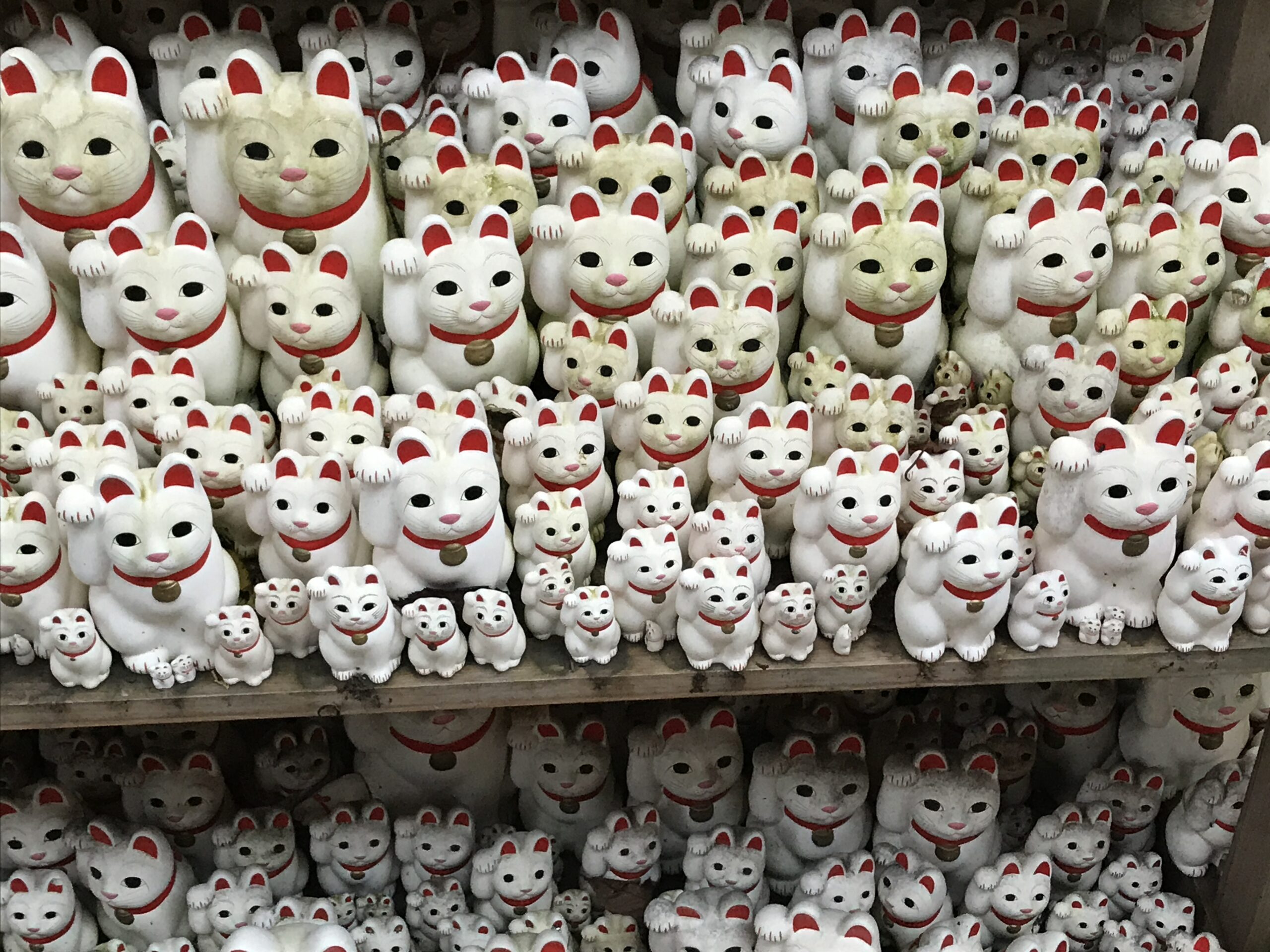
Deep in a quiet residential neighborhood in southwestern Tokyo stands a Buddhist temple that claims to have given the world one of Japan’s most beloved symbols. Gotokuji is the original cat temple in Tokyo, and, for cat lovers, this might be the most impressive thing you will see in all of Japan.
By Tokyo Becky
What is Gotokuji Temple? A Soto Zen Buddhist temple in Setagaya Ward, southwestern Tokyo, widely regarded as the birthplace of the maneki-neko (beckoning cat). Home to thousands of white lucky cat figurines and a stunning three-storied pagoda built in 2006.
Where is it? 2-24-7 Gotokuji, Setagaya-ku. In the Setagaya Ward, and it is about 30 minutes from Shinjuku by train. Shinjuku is my #1 place to stay in Tokyo, especially for your first time. While there, you can also visit Golden Gai, Tokyo’s largest hot spring, and Omoide Yokocho (also known as Piss Alley) while being an easy train ride away from the Cat Temple. Shinjuku also has an amazing 3D cat billboard that you have to see to believe right across the East Exit of the station.
How to get there: Take the Odakyu Line from Shinjuku to Gotokuji Station (approx. 15 minutes), then walk about 10 minutes to the temple. Alternatively, take the Tokyu Setagaya tram line to Miyanosaka Station for a 5-minute walk.
Admission: Free. The temple is open to visitors daily.
Opening hours: Temple grounds 6:00 AM to 5:00 PM (hours may vary seasonally; check the official website before visiting). Temple office (for purchasing figurines, omamori, and ema) 8:00 AM to 3:00 PM.
What to see: The Shofuku-den hall surrounded by thousands of white maneki-neko figurines, the three-storied pagoda, the Ii family cemetery (designated a national historic site in 2008), the bell tower, and the traditional Japanese garden.
Why Is Gotokuji the Most Famous Cat Temple in Tokyo?
There is nothing quite like rounding a corner at Gotokuji Temple and suddenly coming face to face with hundreds of white ceramic cats, all identical, all raising their right paw, all gazing at you with the same calm expression. They fill the shelves of the small Shofuku-den hall from floor to ceiling and spill out onto the surrounding ledges. They range in size from tiny keychain-sized charms to sculptures as tall as your knee. There are thousands of them.
Each one was left by a visitor whose wish came true.
That is the custom at Gotokuji: you purchase a white maneki-neko figurine, take it home, make a wish, and when that wish is granted, you make the journey back and add your cat to the collection as an act of gratitude. What you see when you stand in front of that hall is not a souvenir display. It is an accumulation of answered prayers going back generations.
Gotokuji Temple in Setagaya is the cat temple in Tokyo that started it all. Set in a quiet, tree-lined residential neighborhood far from the tourist crowds, the temple is one of the most genuinely moving places I have visited in Japan. Its atmosphere is peaceful, its history is extraordinary, and its connection to one of the world’s most recognizable folk symbols gives it a significance that no souvenir shop cat figurine can quite convey.
I had the good fortune of living just four train stops away on the Odakyu Line for two and a half years, during a stretch of my life spent in a guesthouse in the suburbs of Tokyo. Growing up with cats, I was completely unprepared for the sheer number of them waiting for you the moment you step onto the grounds. Thousands of ceramic cats, in the middle of an ordinary residential neighborhood, radiating this completely unexpected calm. For cat lovers, I will say it plainly: this is the best place you can visit in the entire country.
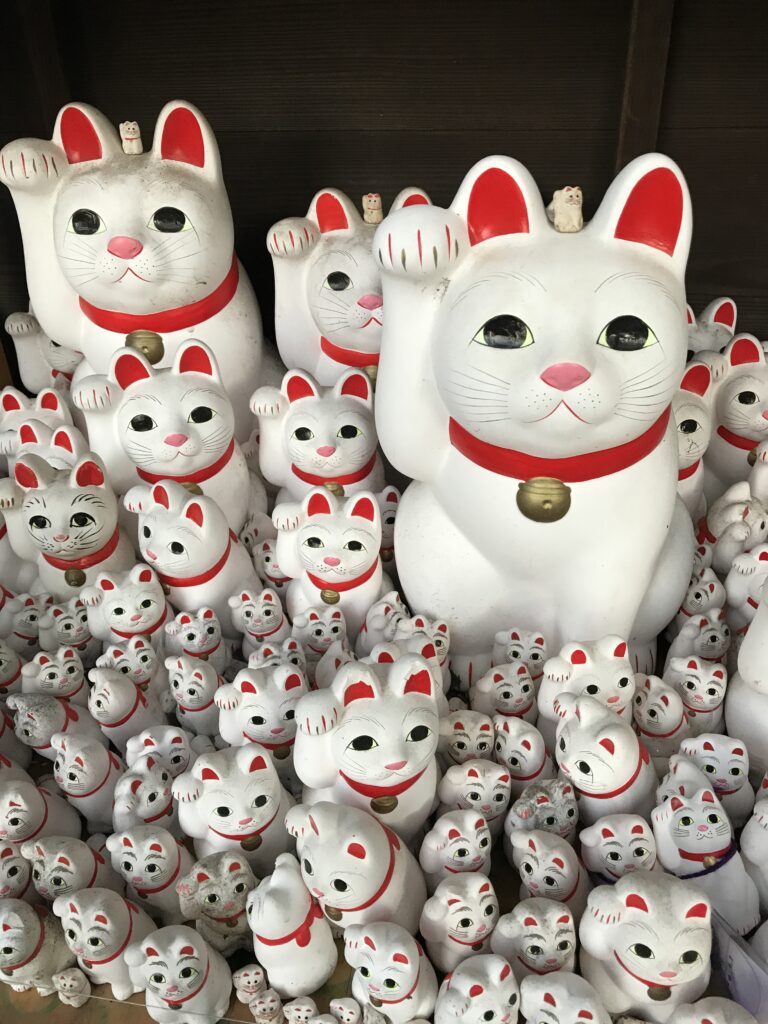
The maneki-neko are everywhere at Gotokuji Temple, the perfect shrine for cat lovers in Tokyo, Photo by Tokyo Becky
This tour combines Gotokuji Temple with a Shinjuku cat cafe and a 3D cat art experience for a full day of cat-themed Tokyo. Perfect if you want to make the most of your time in the city.
Book the Gotokuji Cat Temple, Shinjuku Cat Cafe and 3D Cat Tour
What Is the History of Gotokuji Temple?
The story of Gotokuji begins in 1480, when a lord of the Kira clan, Kira Masayoshi, established a small temple on this site called Kotokuin, originally associated with the Rinzai sect of Buddhism. The temple shifted to the Soto school of Zen Buddhism in 1584, and for much of its early history remained a modest, unremarkable place of worship in what was then the outskirts of Edo.
Everything changed in 1633, when Setagaya came under the control of the Hikone Domain and its ruling Ii clan. Ii Naotaka, the second lord of the domain, became the temple’s great patron. The precise reason for his devotion to this particular temple is bound up in one of Japan’s most celebrated folk legends.
The Legend of the Cat That Saved a Lord
The legend comes in several versions, but all share the same essential story. One day in the early 17th century, Naotaka Ii was returning from a falconry expedition when a sudden and violent thunderstorm struck. He took shelter under a tree at the edge of the temple grounds. A white cat belonging to the temple’s poor monk appeared at the gate and began raising its paw, as if beckoning him inside.
Intrigued, the lord walked toward the cat. The moment he stepped away from the tree, lightning struck the tree where he had been standing. The cat had saved his life. Naotaka entered the temple, drank tea with the monk, and was so moved by his fortune that he became the temple’s patron, donating land, rice, and resources to help it grow.
When the cat eventually died, it was enshrined at the temple as a deity of good fortune, the “Fortune-Inviting Kannon,” or Manekineko Kannon. A small hall was built in the cat’s honor: the Shofuku-den, the hall that still stands today, rebuilt in 1933 and renovated again in 2022, and which remains the spiritual center of the maneki-neko tradition.
After Naotaka’s death in 1659, the temple was renamed Gotokuji, derived from his posthumous Buddhist name: Kyushoin-den Gotoku-tenei-daikoji. The Ii family continued to use the temple as their ancestral burial ground for generations, and today the temple grounds contain one of the largest daimyo family cemeteries in Tokyo.
Gotokuji and the Ii Clan’s Troubled Legacy
The Ii clan’s most famous member, Ii Naosuke, a later lord of the Hikone Domain, is buried at Gotokuji. Naosuke served as Tairo, the highest-ranking official of the Tokugawa shogunate, and was one of the most powerful political figures in Japan in the years immediately before the Meiji Restoration. He was ambushed and killed in 1860 outside the Sakurada Gate of Edo Castle, an event that many historians consider the beginning of the end of the feudal era. His tomb at Gotokuji, tucked among the pines, feels like a remarkably quiet place for so consequential a life to end.
What Are the Maneki-Neko Lucky Cat Figurines at Gotokuji, and What Do They Mean?
The maneki-neko (literally “beckoning cat”) is one of the world’s most recognizable folk talismans. Though they are widely associated with Chinese and Vietnamese communities across the globe, maneki-neko are unambiguously Japanese in origin, and Gotokuji is the place most strongly associated with the birth of the tradition.
The figurines at Gotokuji are distinctive in two important ways that set them apart from the lucky cats you see in shop windows and restaurants elsewhere.
The Right Paw
All the maneki-neko at Gotokuji raise their right paw. In Japanese folk tradition, the paw that is raised carries a different meaning: a left paw raised is said to beckon customers and people, making it the more common choice for businesses and restaurants. A right paw raised is believed to invite wealth, luck, and good fortune more broadly. Gotokuji specializes in the right-pawed version, and every cat figurine sold at the temple office follows this tradition.
No Coin
Most maneki-neko hold an oval gold coin from Japan’s Edo period, called a koban, in their raised paw. The cats at Gotokuji hold nothing. This is a deliberate philosophical distinction. According to the temple, the Gotokuji maneki-neko does not promise material wealth or guarantee happiness directly. Instead, it creates connections: between people, between effort and opportunity, between gratitude and good fortune. The absence of the coin is a reminder that luck must be cultivated through one’s own actions and relationships. I found this distinction unexpectedly moving when I first encountered it.
White Ceramic, Every Size
The figurines are made primarily from white ceramic and come in a range of sizes, from tiny versions you can slip onto a keychain to large, weighty sculptures that take two hands to carry. At the temple office, prices run from approximately 500 yen for the smallest sizes to around 7,000 yen for the largest. All are white, and all raise the right paw with the same beckoning gesture.
There is also a larger stone maneki-neko statue near the Shofuku-den hall. This is the Manegi-Neko, the original enshrined cat. It is not for sale. It simply stands and beckons, as it has for centuries.
If you are lucky, you will also spot a real cat or two on the temple grounds. Live cats do appear at Gotokuji from time to time. A black and white female known to regular visitors as Tama-san was spotted on the grounds as recently as late 2025. Seeing a temple cat is considered an especially good omen.
What Is There to See on the Grounds of Gotokuji Temple?
The temple grounds cover approximately 50,000 square meters, which makes Gotokuji considerably larger than most visitors expect. Beyond the famous maneki-neko display, there is a great deal to explore.
The Shofuku-den Hall
This is the heart of the Gotokuji maneki-neko experience: a small hall dedicated to the cat deity that saved Ii Naotaka. The hall itself was originally built in 1933, renovated most recently in 2022, and is surrounded on all sides by shelves and ledges filled with thousands of white figurines. The effect is striking. Visitors stand in silence taking photographs, and there is a quiet contemplative atmosphere here that surprised me. This is not merely a photo opportunity. It is a place of genuine devotion.
The Three-Storied Pagoda (Sanju-no-to)
Inaugurated in May 2006, the three-storied pagoda stands 22.5 meters high and is one of the most beautiful structures on the temple grounds. It enshrines statues of Shakyamuni Buddha, Kasho-sonja, and Anan-sonja, along with a Manekineko-Kannon. The exterior is decorated with carved cats and the twelve signs of the Chinese zodiac. It is particularly lovely in autumn, when the surrounding maple trees turn red and frame the tower in color.
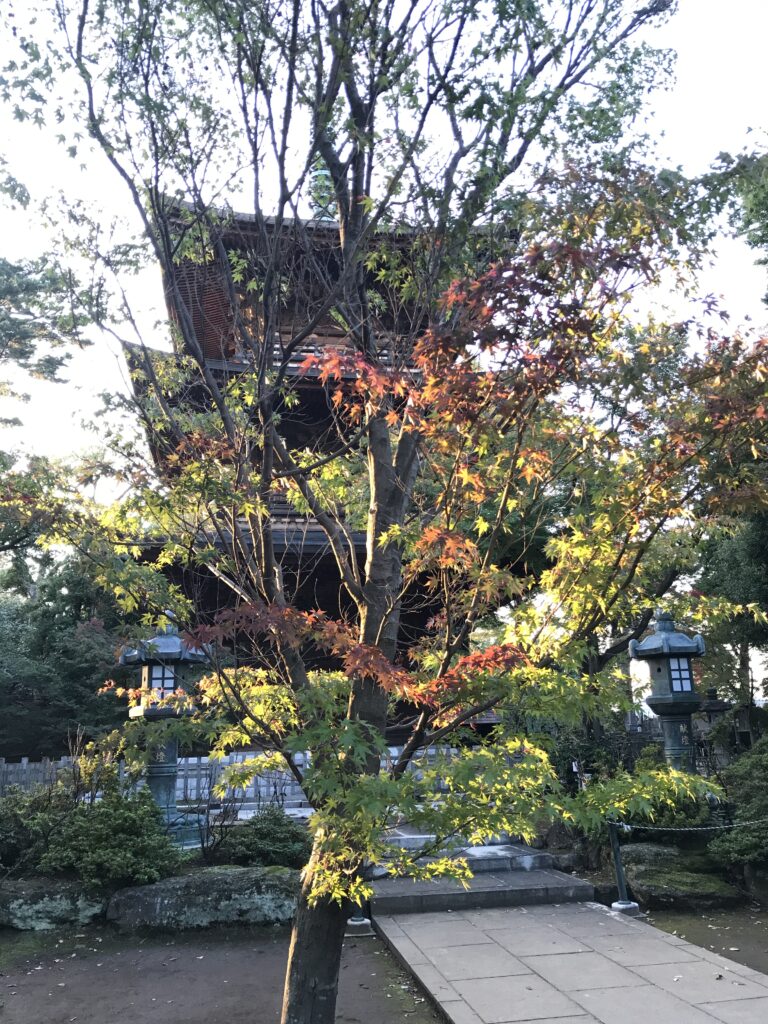
The pagoda at Gotokuji Temple through the beautiful fall leaves, one of the most beautiful times of the year to visit the Cat Temple, Photo by Tokyo Becky
The Main Hall (Honden) and Buddha Hall (Butsu-den)
Gotokuji’s main hall is a stately example of Edo-period temple architecture, befitting a place that served as the ancestral temple of one of Japan’s most powerful daimyo families. Stone lanterns line the approach. The Buddha Hall contains religious statuary and objects of cultural significance. Both buildings have a dignified gravity that reminds you this is very much a working Zen Buddhist temple, not a tourist attraction.
The Bell Tower
The ceremonial bell tower dates from the 17th century and houses Gotokuji’s historic Bonsho bell, which was designated as a Setagaya tangible cultural property in the year 2000. Crafted by Masatsugu Fujiwara, also known as Rokuemon Kamaya, it is considered the most historically significant Buddhist bell in the Setagaya area.
The Ii Family Cemetery
At the rear of the temple grounds lies one of the most significant historical sites in Tokyo: the Ii family cemetery, designated a national historic site in 2008. Approximately 300 members of the Ii clan are buried here, including Ii Naotaka, the lord who made Gotokuji the family’s ancestral temple, and Ii Naosuke, the powerful Tairo whose 1860 assassination marked the beginning of the end of the Tokugawa shogunate. The cemetery preserves the classic Edo-period pattern for daimyo family tombs and is one of the largest of its kind in the entire Tokyo area. Visitors are welcome to view the grounds respectfully.
The Garden and Seasonal Flora
Gotokuji’s 50,000-square-meter grounds are planted with plum trees, cherry trees, peonies, azaleas, hydrangeas, ginkgo trees, and maples, making it a rewarding destination in every season. The plum blossoms arrive in late February. Cherry blossoms follow in late March and early April. Peonies bloom in May. Autumn foliage turns the grounds gold and red from late October through November. In any season, the grounds have the feel of a genuine urban oasis: quiet, local, and unhurried.
The Sanmon Gate
The main temple gate, called the Sanmon Hekiunseki, carries an inscription that translates roughly as “a gate built to separate the outside world and the precinct.” Passing through it does feel like a transition: the noise and pace of Setagaya falls away almost immediately, and the temple’s quiet imposes itself.
The Akamon Red Gate
Near the Shofuku-den hall you will find the Akamon, or red gate, donated by the Ii family to the temple. Passing through this smaller inner gate brings you toward the maneki-neko collection. A small black maneki-neko statue near the gate serves as a marker that you are on the right path.
What Can I Do at the Gotokuji Cat Temple in Tokyo?
Buy a Maneki-Neko Figurine
The temple office sells white maneki-neko figurines in multiple sizes, ranging from approximately 500 yen to 7,000 yen. You can take your cat home as a personal talisman and return it to the temple once your wish is granted. Many visitors treat the purchase and eventual return as a small act of pilgrimage.
Draw Omikuji (Fortune Slips)
The temple office sells omikuji, the traditional Japanese fortune slips that predict your luck across various domains of life: health, love, work, travel, and more. If you receive a good fortune, keep it. If you receive an unfavorable one, tie it to the branch of a tree near the reception area to leave the bad luck behind. Staff at the temple are welcoming to international visitors and can help indicate whether your fortune is auspicious or not.
Write an Ema Plaque
Wooden ema plaques featuring the Gotokuji maneki-neko are available at the temple office. You write your wish or prayer on the reverse side and hang it on the designated wall alongside those of other visitors. The emas at Gotokuji are all decorated with the cat in its characteristic beckoning pose.
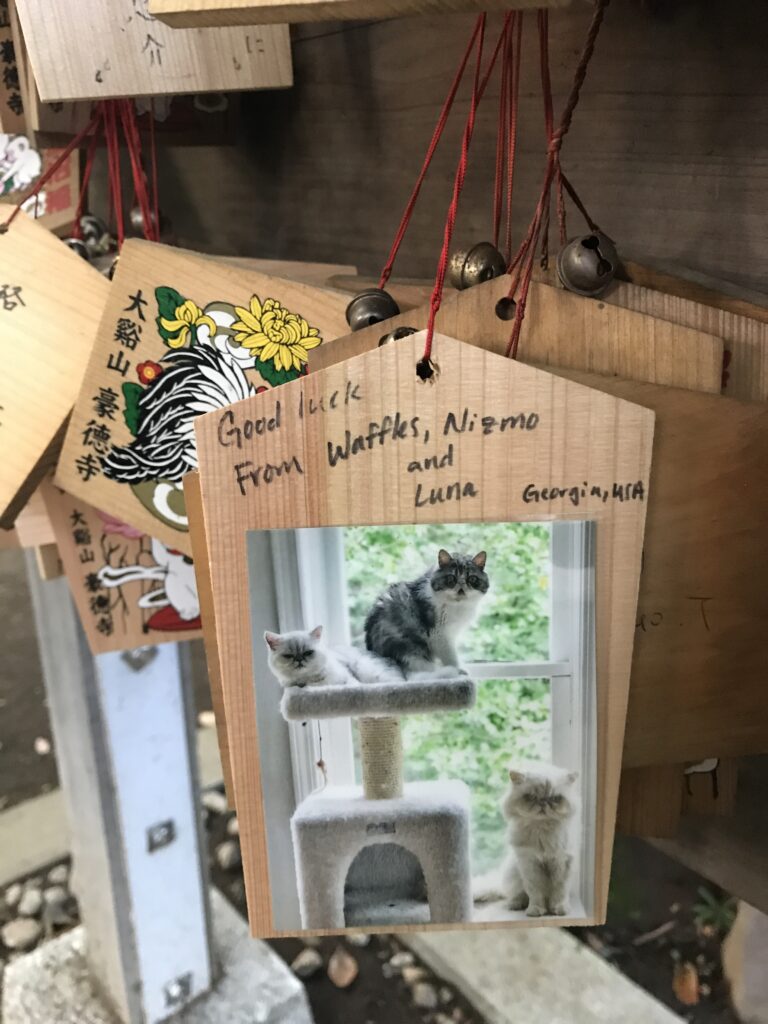
One of the beautiful ema plaques at Gotokuji Temple, Photo by Tokyo Becky
Collect a Goshuin Stamp
For visitors who collect goshuin, the traditional red ink stamps and calligraphy that serve as temple visit records, Gotokuji offers a goshuin service at the temple office during opening hours. Stamp books are also available for purchase if you do not have one.
Ride the Lucky Cat Train
One of the most charming ways to reach Gotokuji is on the Tokyu Setagaya Line, one of only two remaining street tram lines in Tokyo. The line operates a special service called the Kofuku-no-Manekineko Densha, or the Lucky Cat Train: a tram decorated inside and out with maneki-neko imagery, including cat-shaped hanging handles and cat-paw patterns on the floor.
There are two routes to the Gotokuji Cat Temple in Tokyo. The first is to take the Odakyu Line from Shinjuku Station directly to Gotokuji Station, then walk 12 minutes to the temple. The second is to take the Den-en-toshi Line to Sangenjaya Station, walk five minutes to transfer to the Tokyu Setagaya Line, and ride the tram to Miyanosaka Station, which is a four-minute walk from the temple entrance. If riding the Lucky Cat Train is a priority, you need to take the second option, as the cat tram runs on the Tokyu Setagaya Line only.
The schedule changes daily. On some days the cat tram does not run in the morning at all; on others it runs throughout the day. When it does run, the first departure is generally after 7:00 AM, and there is typically one or two cat tram services per hour. Most of the time you will board an ordinary tram, and occasionally one with other designs. Catching the Lucky Cat Train is genuinely a matter of luck, which feels entirely appropriate given the destination.
Cat-Themed Treats at Rarasand Bakery
On your way back to Gotokuji Station, make a stop at Rarasand, a bakery near the station that sells maneki-neko-shaped treats filled with a range of flavors. The bakery also has a cafe menu, which makes it an ideal place to rest after a morning at the temple. It is a charming addition to your visit that very much fits the spirit of the neighborhood and is open every day from 10:10 AM – 5:00 PM.
How Do I Get to the Cat Temple in Tokyo?
| Departing From | Route | Journey Time | Walk to Temple |
|---|---|---|---|
| Shinjuku | Odakyu Line to Gotokuji Station | Approx. 15 minutes | Approx. 10 minutes |
| Sangenjaya | Tokyu Setagaya Line to Miyanosaka Station | Approx. 10 minutes | Approx. 5 minutes |
| Shibuya | Den-en-toshi Line to Sangenjaya, then Setagaya Line to Miyanosaka | Approx. 20 minutes | Approx. 5 minutes |
Note: The Odakyu Line is not covered by the JR Rail Pass. It is, however, a simple and inexpensive option from Shinjuku. IC cards (Suica, Pasmo) are accepted.
Shinjuku is the most convenient base for visiting the Gotokuji Cat Temple in Tokyo, with direct Odakyu Line access and a huge range of hotels at every price point.
What Do I Need to Know Before Visiting the Gotokuji Cat Temple in Tokyo?
Is Gotokuji Temple free to enter? Yes. Admission to the temple grounds is free, and the temple opens at 6:00 AM and closes at 5:00 PM. The temple office, where you can purchase maneki-neko figurines, ema plaques, omikuji, and omamori amulets, is open from 8:00 AM to 3:00 PM.
When is the best time to visit Gotokuji? The temple is beautiful in every season, but autumn (late October through November) is exceptional, when the maple trees frame the pagoda in red and gold. Spring cherry blossoms (late March to early April) also draw visitors. For the fewest crowds, arrive early in the morning on a weekday. New Year’s is the busiest period, as many visitors come to dedicate new cat figurines at the start of the year.
How long does a visit to the Gotokuji Cat Temple in Tokyo take? Most visitors spend between 45 minutes and 90 minutes at the temple. If you plan to walk the full grounds, explore the cemetery, and sit quietly in the garden, allow two hours.
Is there anything to do near the Gotokuji Cat Temple in Tokyo? Gotokuji is on the same train line as Shimokitazawa, one of Tokyo’s most interesting neighborhoods for vintage clothing, independent cafes, live music venues, and theater. I even wrote a book about it, which you can purchase here. It makes an excellent pairing with a temple visit. There is also a traditional sweet shop just outside the temple grounds selling dorayaki pancakes decorated with the maneki-neko image.
Is Gotokuji suitable for children? Very much so. The cat figurines are immediately delightful to young visitors, and the temple grounds are spacious, walkable, and peaceful. Children often enjoy looking for hidden cat sculptures around the grounds.
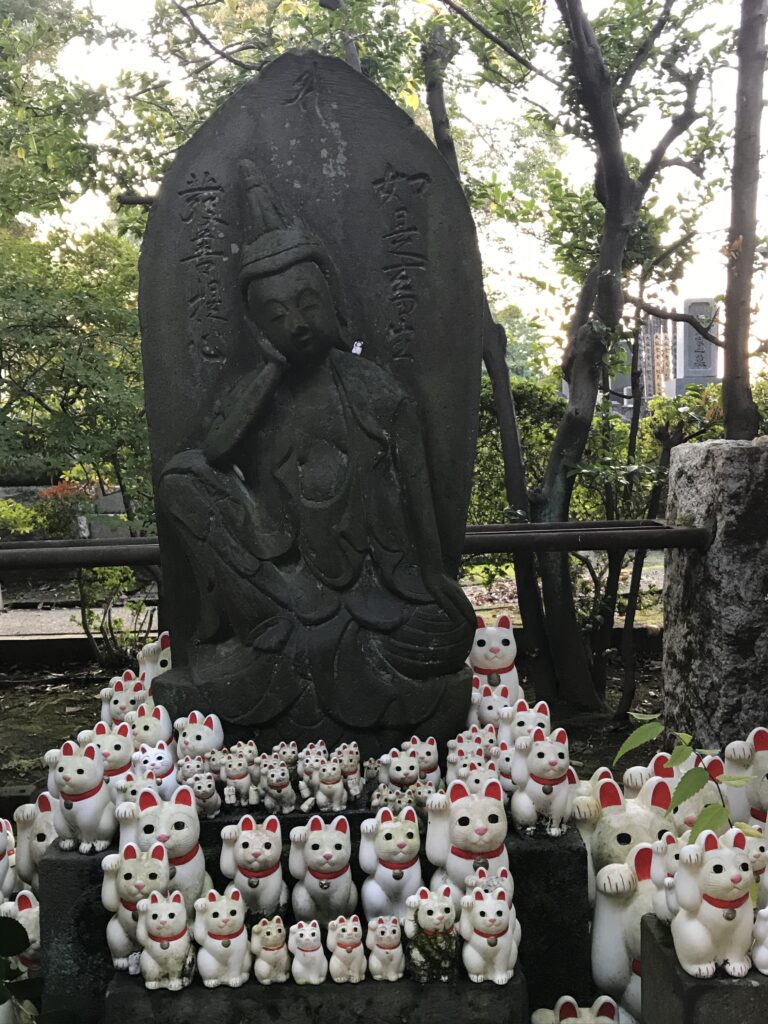
Maneki-neko at the foot of Buddha, Photo by Tokyo Becky
Is the Cat Temple in Tokyo Worth Visiting?
Completely and without reservation. The Gotokuji Cat Temple in Tokyo is one of those places that is absolutely worth the trip and will give you a nice break from the tourist center of Tokyo. The temple is free to enter, genuinely beautiful in every season, historically significant far beyond the charm of its famous cat collection, and carries an atmosphere of quiet that feels increasingly rare in a city of 14 million people.
Standing in front of the Shofuku-den hall and looking at those thousands of white cats, each one representing a wish granted and a grateful return visit, I felt something I did not entirely expect: moved. This is a place that people keep coming back to. That is, perhaps, the best possible recommendation for any destination.
If you love Japan, folk history, beautiful temple architecture, or simply the idea of a place where thousands of people have gathered to give thanks for good fortune, Gotokuji is essential.
Combine Gotokuji Temple with a Shinjuku cat cafe and a 3D immersive cat art experience for an unforgettable full-day Tokyo itinerary.
Frequently Asked Questions about Gotokuji Temple, Tokyo’s Cat Temple
What is Gotokuji Temple famous for?
Gotokuji Temple in Setagaya, Tokyo, is famous as the birthplace of the maneki-neko, or lucky beckoning cat. The temple houses thousands of white ceramic maneki-neko figurines left by visitors whose wishes were granted. It is widely regarded as the original cat temple in Tokyo and the place where the maneki-neko tradition began in the early 17th century.
Where is Gotokuji Temple located?
Gotokuji Temple is located at 2-24-7 Gotokuji, Setagaya-ku, in the Setagaya Ward of southwestern Tokyo. It is approximately 15 minutes by Odakyu Line train from Shinjuku Station, and about 5 minutes walk from Miyanosaka Station on the Tokyu Setagaya tram line.
Is Gotokuji Temple free to enter?
Yes, admission to Gotokuji Temple is completely free. The temple grounds are open to visitors daily from 6:00 AM to 5:00 PM (hours may vary seasonally). The temple office, where you can purchase maneki-neko figurines (from approximately 500 yen to 7,000 yen depending on size), ema plaques, omikuji fortune slips, and omamori amulets, is open from 8:00 AM to 3:00 PM.
What is the story behind the lucky cat at Gotokuji Temple?
According to temple legend, in the early 17th century, Ii Naotaka, the second lord of the Hikone Domain, was caught in a violent thunderstorm. A white cat belonging to the temple’s monk appeared at the gate and raised its paw to beckon him inside. He followed the cat, and at that moment lightning struck the tree where he had been standing. The cat had saved his life. Naotaka became the temple’s patron, funded its restoration, and the cat was later enshrined as the “Fortune-Inviting Kannon.” This is the founding legend of the maneki-neko tradition.
How do I get to Gotokuji Temple from Shinjuku?
From Shinjuku Station, take the Odakyu Line (Odawara Line direction) directly to Gotokuji Station. The journey takes approximately 15 minutes. From Gotokuji Station, the temple is a 10-minute walk. Alternatively, from Shinjuku you can take the train to Shimokitazawa and then transfer to the Setagaya tram line to Miyanosaka Station, which is a 5-minute walk from the temple. Note that the Odakyu Line is not covered by the JR Rail Pass. Check the times here to take the cat train to the cat temple.
What is the difference between the maneki-neko at Gotokuji and lucky cats elsewhere?
The maneki-neko at the Gotokuji Cat Temple in Tokyo are distinctive in two ways. First, all of them raise the right paw, which in Japanese tradition is associated with inviting wealth and good fortune (left-pawed cats are more common in businesses and are said to beckon customers). Second, none of the Gotokuji cats hold a coin, unlike most maneki-neko found in shops and restaurants. The temple teaches that the cat invites connections and opportunities, but that it is up to each person to make their own fortune through effort and gratitude.
What else is there to see at Gotokuji besides the lucky cat figurines?
Gotokuji Temple has a great deal to offer beyond its famous maneki-neko collection. The temple grounds include a three-storied pagoda (22.5 meters tall, opened in 2006) decorated with carved cats and zodiac signs, a 17th-century bell tower housing one of the oldest bells in Setagaya, the main hall and Buddha hall of a working Zen Buddhist temple, the Ii family cemetery (a national historic site since 2008 where approximately 300 members of the Hikone clan are buried, including Ii Naosuke), and extensive gardens planted with cherry trees, plum trees, maples, azaleas, and peonies that offer beautiful seasonal color throughout the year.
When is the best time to visit Gotokuji Temple?
The Gotokuji Cat Temple in Tokyo is beautiful year-round. Autumn (late October through November) is widely considered the finest season, when red and gold maple leaves frame the pagoda. Spring cherry blossoms (late March to early April) are also spectacular. To avoid crowds, arrive early in the morning on a weekday. The temple is busiest around New Year, when many visitors come to dedicate new maneki-neko figurines. The Shofuku-den hall is said to hold the most figurines in January and February following the New Year season.
Is Gotokuji Temple worth visiting?
Yes. Gotokuji Temple is one of Tokyo’s most rewarding and undervisited destinations. Admission is free, the grounds are spacious and beautiful in every season, the maneki-neko display at the Shofuku-den hall is genuinely moving, the pagoda and 17th-century bell tower are architecturally significant, and the Ii family cemetery is a national historic site. For visitors interested in Japanese folk culture, Buddhist temple architecture, or simply an escape from Tokyo’s more crowded tourist circuits, the Gotokuji Cat Temple in Tokyo is an excellent choice.



0 Comments