
By Tokyo Becky
Most people think of neon and skyscrapers when they picture Tokyo. What they do not picture is being buried in the sand in a hot outdoor spring surrounded by Greek-style stone columns or a coral reef so clear you can see sea turtles feeding 15 feet below the hull of your kayak. Tokyo’s islands, strung across 1,000 kilometers of the Pacific, have all of this and more. Some you can reach in under two hours from the city center. Others require a full day at sea. Every single one is worth it.
How many islands does Tokyo have? Eleven islands are all officially part of the Tokyo metropolis: the 9 Izu Islands (Oshima, Toshima, Niijima, Shikinejima, Kozushima, Miyakejima, Mikurajima, Hachijojima, and Aogashima) and two Ogasawara Islands (Chichijima and Hahajima). Most are managed as part of Tokyo Metropolis despite being hundreds of kilometers from the city.
Ferry operator for the Izu Islands: Tokai Kisen. Ferries depart from Takeshiba Pier, a 10-minute walk from Hamamatsucho Station. Jet ferries (high-speed) serve Oshima, Toshima, Niijima, Shikinejima, and Kozushima. Overnight large passenger ships serve the more distant islands. It should be noted here that Hamamatsucho Station is the end point for the Haneda AirPort monorail. So, technically, you could land in Tokyo Haneda Airport, take the monorail to Hamamatsucho and head straight to the ferry and get to the islands from there! Beautiful beaches, here we come!
Ferry operator for the Ogasawara Islands: Ogasawara Kaiun. The Ogasawara Maru departs Takeshiba Pier roughly once a week and takes 24 hours to reach Chichijima! There is no airport. You can book here.
Closest island to Tokyo: Izu Oshima. A jet ferry from Tokyo takes approximately 1 hour 45 minutes.
Best island for surfing: Niijima. Habushiura Beach is Japan’s premier surf beach, with consistent waves year-round. By high-speed jet ferry, it takes about 2 hours 50 minutes. By overnight large passenger ship, it takes around 8–9 hours.
Best island for onsen: Niijima (Yunohama Roten Onsen, free, 24 hours, Greek-style architecture) and Shikinejima (clifftop ocean-edge springs).
Only UNESCO World Heritage islands near Tokyo: Ogasawara Islands (Chichijima and Hahajima), inscribed in 2011.
Most remote island near Tokyo: Aogashima, 358 km south of Tokyo. Population: approximately 200. Accessible by helicopter or infrequent ferry from Hachijojima.
Best island for a day trip from Tokyo: Izu Oshima. The jet ferry takes approximately 1 hour 45 minutes each way, leaving enough time to hike the Mount Mihara volcano rim and soak in an onsen before the return crossing.
Best islands for a weekend trip from Tokyo: Niijima and Shikinejima, which reward two to three nights and are well served by the overnight large passenger ship.
Why Should I Visit the Islands Near Tokyo?
Most visitors to Japan are unaware that a chain of volcanic islands stretching all the way to the subtropics is technically considered part of the Tokyo Metropolis. There are actually two chains of islands: the Izu Islands and the Ogasawara Islands.
The Izu Islands, reachable by jet ferry in less than hours from Tokyo’s Takeshiba Pier, offer a completely different experience than the fields of skyscrapers in central Tokyo: deserted black-sand beaches, active calderas you can walk into, world-class surf breaks, wild dolphins, and outdoor hot springs where you soak under open sky.
Further south, a full 24-hour ferry ride from Takeshiba Pier, the Ogasawara Islands are among the most extraordinary natural places in Japan. They officially became a UNESCO World Natural Heritage Site in 2011 for their exceptional biodiversity. The two islands, Chichijima and Hahajima, have no airport. The only way in is the Ogasawara Maru, a 24-hour ferry journey that is itself an adventure. Humpback whales breach alongside the ship. Flying fish skim the bow wave. By the time you arrive, you feel genuinely far from the world and don’t expect to have WiFi on the ferry. Plan to be completely disconnected.
I have camped in a field on Niijima, been buried up to my neck in hot volcanic sand at Mamashita Onsen, and then soaked in a free outdoor hot spring with a cold beer, surrounded by stone columns designed in the style of an ancient Greek temple, watching the sun drop into the Pacific. That experience alone, in my opinion, is worth the overnight ferry ride. The islands near Tokyo are one of Japan’s great secrets, and this guide will help you reach every single one of them.
It only takes two hours to get to Izu Oshima from Tokyo. Explore lava flows from past eruptions and see the central crater close on a 3.5 hour trek
How Do I Get to the Tokyo Islands by Ferry?
All ferries to the Izu Islands and the Ogasawara Islands depart from Takeshiba Passenger Terminal in central Tokyo, a 10-minute walk from JR Hamamatsucho Station or a 1-minute walk from Yurikamome Takeshiba Station.
Izu Islands: Tokai Kisen Ferries
Tokai Kisen operates all scheduled ferry services to the Izu Islands. There are two types of vessels: the high-speed jet ferry (jetfoil), which serves Oshima, Toshima, Niijima, Shikinejima, and Kozushima; and the large passenger ship (Tachibana-maru or Salvia-maru), a slower overnight vessel that also reaches Miyakejima, Mikurajima, Hachijojima, and Aogashima. Keep reading below to find out what the ferry is like.
| Island | Ferry Type | Journey Time from Tokyo | Notes |
|---|---|---|---|
| Izu Oshima | Jet ferry or large ship | Approx. 1 hr 45 min (jet) / 6-8 hrs (large ship, overnight) | Most frequent service. Daily jet ferry during peak seasons. |
| Toshima | Jet ferry or large ship | Approx. 2.5 hrs (jet) | Small island; limited jet ferry schedule. Check the Tokai Kisen timetable. |
| Niijima | Jet ferry or large ship | Approx. 2.5-3.5 hrs (jet) / 10.5 hrs (large ship, overnight) | Jet ferry runs mainly during summer season. |
| Shikinejima | Jet ferry or large ship | Approx. 2.5-3.5 hrs (jet, via Niijima) | Also reachable by short ferry from Niijima (15 min). |
| Kozushima | Jet ferry or large ship | Approx. 3.5 hrs (jet) / 12 hrs (large ship) | Jet ferry in peak summer season only. |
| Miyakejima | Large passenger ship (overnight) | Approx. 6.5 hrs (arrives early morning) | Departs Tokyo ~10:30 pm. No jet ferry service. |
| Mikurajima | Large passenger ship (overnight) | Approx. 8 hrs (arrives early morning) | No airport. Ferry is the only access. |
| Hachijojima | Large passenger ship (overnight) | Approx. 10.5 hrs (arrives ~09:00) | Also reachable by ANA flight from Haneda (~55 min). |
| Aogashima | Ferry from Hachijojima or helicopter | Approx. 2.5 hrs by ferry from Hachijojima | Helicopter (9 seats) is more reliable. Ferries cancel frequently. Book well ahead. |
| Chichijima (Ogasawara) | Ogasawara Maru (Ogasawara Kaiun) | 24 hours from Tokyo | Departs roughly once a week (more in peak seasons). No airport. |
| Hahajima (Ogasawara) | Hahajima Maru from Chichijima | Approx. 2 hrs from Chichijima | Hahajima Maru tickets are sold on the day; cannot be reserved in advance. |
How Do I Buy Tokai Kisen Ferry Tickets?
The best approach is to book through the Japanese-language Tokai Kisen website using a browser translation tool. This allows you to create an account, choose your cabin class, and receive a digital ticket. The English-language version of the site requires you to fill in a contact form and wait for a response rather than booking directly. Tickets can also be purchased at the Takeshiba Terminal ticket counter on the day of departure, but jet ferry seats and private cabins sell out quickly during summer weekends and Golden Week. For the Ogasawara Islands, book through Ogasawara Kaiun, which has an English booking option.
What Is the Ferry Like?
The jet ferry is fast, enclosed, and feels like a low-flying aircraft. Seats are assigned. The trip times are short enough that there is little to do except watch your island of choice appear on the horizon. The large passenger ships are a different experience entirely. The Tachibana-maru and Salvia-maru have multiple cabin classes: private rooms with beds and en-suite showers (first class), shared bunk rooms, and open tatami mat floor space in economy class. There is a restaurant, a lounge, vending machines, and outside decks from which you can watch Tokyo’s lights fade into the dark Pacific. The overnight crossing to Miyakejima or Hachijojima will save you the cost of a night in a hotel and will drop you off at the island at dawn, which is a genuinely beautiful way to arrive. Pack seasickness medication. Swells in the Kuroshio Current can be significant especially in autumn and winter.
What Makes Each Island Near Tokyo Unique?
Each of the Tokyo islands are unique. Here is what makes each one worth visiting from the closest to the most remote.
1. Izu Oshima: Tokyo’s Closest Island Escape
Distance from Tokyo: 120 km. Ferry time: approx. 1 hr 45 min by jet ferry.
Izu Oshima is the largest and most accessible of all Tokyo’s islands, and the only one realistically doable as a day trip from Tokyo on the jet ferry. It is also an outstanding choice for a weekend trip from Tokyo with enough to fill two comfortable days. Its centerpiece is Mount Mihara, an active stratovolcano that last erupted in 1986. The crater is accessible by bus and on foot, and walking the rim of an active caldera while looking down into its steaming interior is one of the most visceral experiences available within two hours of Tokyo. The island’s coastline alternates between dramatic black basalt lava rock and sandy beach with the famous Tsubaki (camellia) forest blanketing the slopes in late winter and early spring.
Oshima is also notable for its Oshima Onsen Hotel and numerous public baths fed by geothermal springs, and for a stretch of coast called the Lava Desert, where the 1986 eruption’s black flows have left a moonscape of extraordinary desolation. The ferry to Oshima runs daily during peak seasons from both Tokyo Takeshiba and, seasonally, from Tateyama or Kurihama, making it the easiest introduction to the island chain.
Where to stay on Oshima: The island has a range of ryokan, guesthouses, and hotels clustered around Motomachi Port and Okata Port. Note that the operating port changes daily based on weather and sea conditions; check the Tokai Kisen website the morning of your arrival.
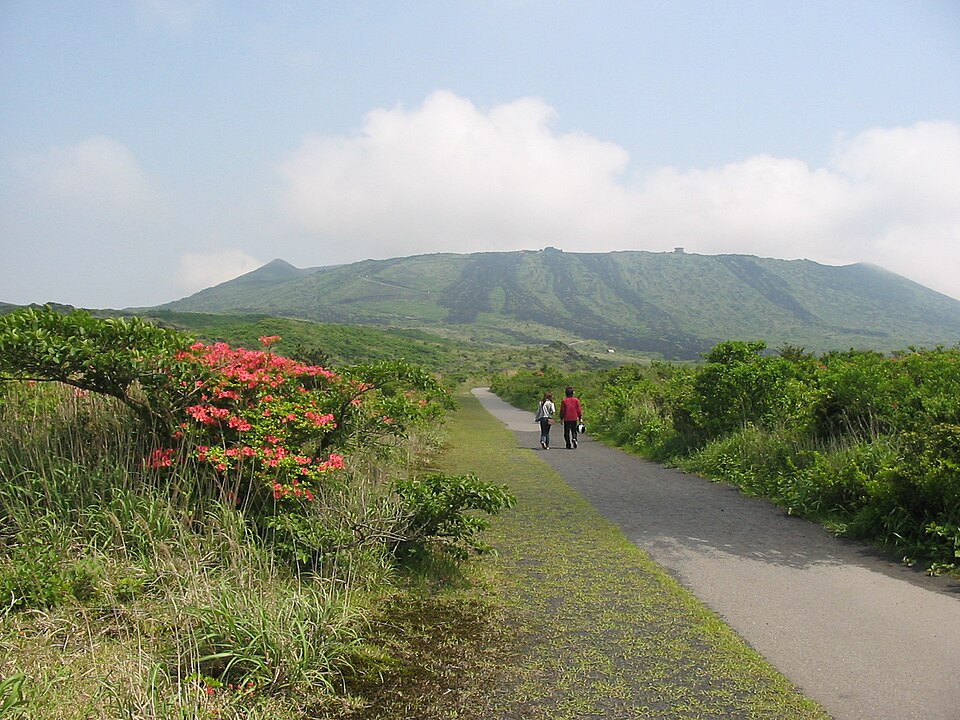
Mount Mihara with azaleas in the foreground on Izu Oshima, Donners, Wikimedia Commons
2. Toshima: The Camellia Island
Distance from Tokyo: 160 km. Ferry time: approx. 2.5 hrs by jet ferry.
Toshima is the smallest of Tokyo’s inhabited Izu Islands and the one that has changed least. With a permanent population of fewer than 300 people, it has no traffic lights, no convenience stores, and no sense of hurry whatsoever. The entire island is essentially a single volcanic cone covered in camellia trees, which bloom in a spectacular blaze of red and pink from January through March. Toshima’s coastline is rugged and rocky rather than sandy, and the island’s main draws are its absolute quiet and the chance to experience what island life in this part of Japan looked like before tourism arrived. There is a small guesthouse and minshuku accommodation, but visitor numbers are low and facilities minimal. Come for the solitude. It will be better if you can book accommodation using a Japanese phone or have a Japanese speaking person come with you on your trip. There is always Google Translate – good luck!
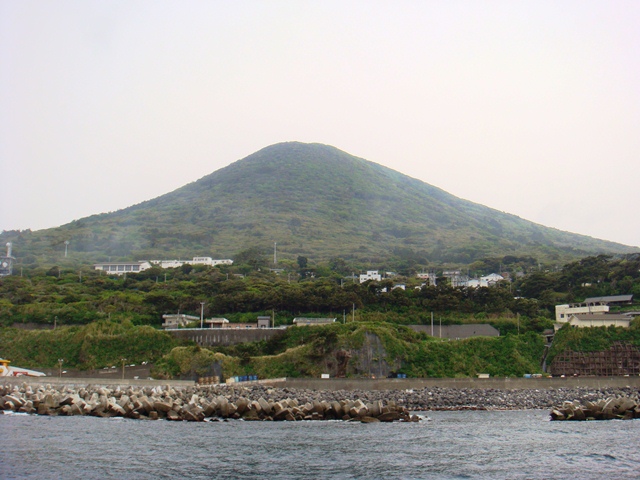
Toshima Island, seen from offshore, Wikimedia Commons
3. Niijima: Japan’s Surf Capital + a Greek Temple Onsen
Distance from Tokyo: 160 km. Ferry time: approx. 2.5-3.5 hrs by jet ferry (summer); approx. 10.5 hrs by overnight large ship.
Niijima is the island that first got me hooked on the Izu Islands. It is Japan’s best-known surf destination, and with good reason: Habushiura Beach on the island’s east coast is a four-kilometer stretch of fine white sand facing directly into the Pacific swell, with consistent waves year-round and a surfer culture that is warm rather than territorial. The beach faces several different directions, meaning you can nearly always find a working break regardless of the wind. Novice swimmers should note that the open-water conditions are powerful; Mamashita Beach on the west coast has calmer, more sheltered spots.
On my last trip to Niijima, I arrived by overnight ferry, set up a tent in one of the island’s campgrounds, and spent three days in a rhythm of sunrise surfs, afternoon cycling, and evenings split between two extraordinary onsen experiences. The first was the Mamashita Onsen sand bath, where attendants bury you to the neck in hot volcanic sand brought from Habushiura. It is stranger and more pleasurable than it sounds. The sand is white and fine, the heat works into every joint, and the sense of physical release when they dig you out is considerable.
The second experience was the Yunohama Roten Onsen, and it is one of the best things I have done in Japan. This free, open-air hot spring sits on a clifftop overlooking the port, about a 10-minute walk from the ferry terminal. What makes it immediately unforgettable is its architecture: the facility is built from kogaseki, a type of white rhyolite found only on Niijima and on Lipari Island in Italy, and its columns, arches, and stone basins are modeled directly on ancient Greek design. Six baths of varying sizes hold up to 80 people, and they are free and open 24 hours a day. I arrived at dusk with a cold can of beer, sank into one of the upper pools, and watched the sun go down over the ocean while the sky went from pink to deep blue to full stars. Go at sunset. Or go at midnight. Both are extraordinary.
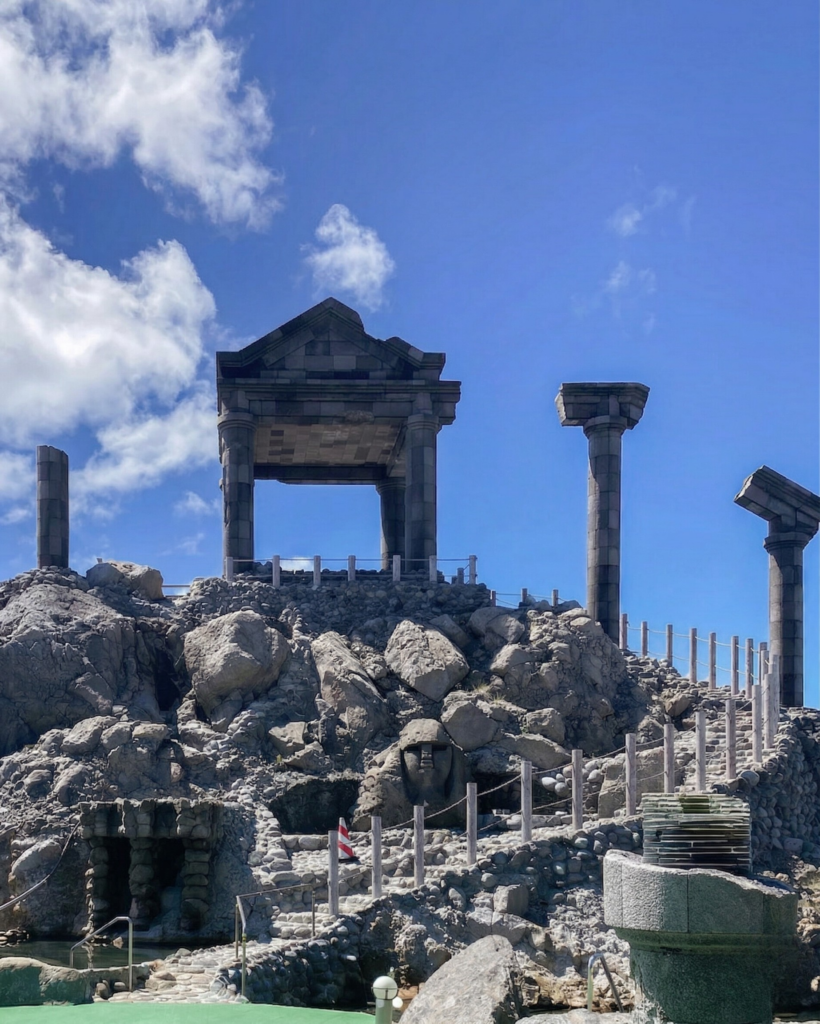
Yunohama Roten Onsen, open 24 hours a day, Niijima Island
Niijima is also known for its Moyai sculptures: stone figures carved from the same kogaseki rhyolite, scattered across the island. The word “moyai” means “to help each other” in the local dialect. You will find them on street corners, at the beach, and at the base of the Greek-style onsen building. They are endearing and slightly mysterious in equal measure.

Doraemonvisits Niijima High School. A moyai sits in the upper right of the photo, DDD_DDD, Wikimedia Commons
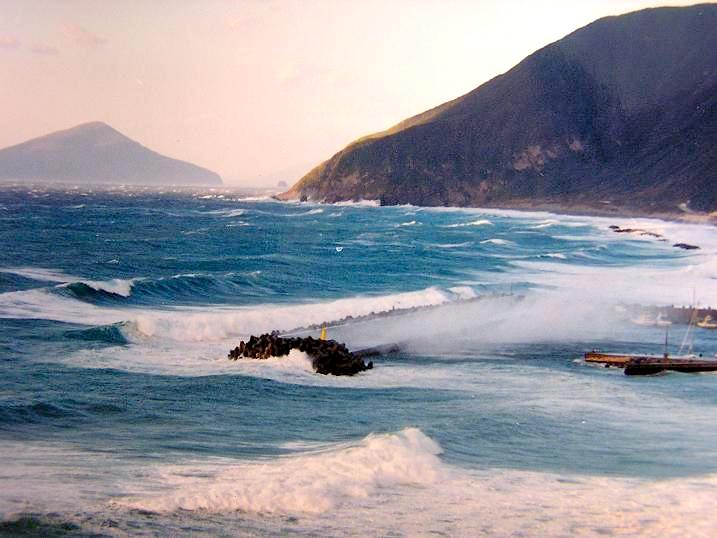
The Western, or Maehama side of Niijima with December waves crashing through the port. Toshima is the island top left, DDD_DDD, Wikimedia Commons
Where to stay on Niijima: Camping is popular and inexpensive, with several designated sites near the beach. The island also has guesthouses, minshuku, and small hotels concentrated around Niijima Port.
4. Shikinejima: The Onsen Island at the Edge of the Ocean
Distance from Tokyo: 170 km. Ferry time: approx. 15 min by small ferry from Niijima; or directly via overnight ship from Tokyo.
Shikinejima sits just 15 minutes by small inter-island ferry from Niijima and is so close that the two islands are administered as a single village. However, Shikinejima has a character entirely its own. It is smaller, quieter, and arguably has the most spectacular onsen collection of any island in the group. The most remarkable is Jinata Onsen, a natural hot spring wedged into a cleft in the volcanic rocks on the island’s eastern coast. There is no facility here: just a series of rock pools, with a direct connection to the sea, so the temperature of the water rises and falls with the tide. At low tide the water is almost too hot to enter; at high tide the cool ocean pours in and balances it perfectly. Lonely Planet has included it in its Japan onsen top ten. There is nothing built around it. It is simply nature doing something extraordinary in a gap in the rocks.
A second outdoor spring, the Ashizuki Onsen near Ashizuki Port, is a free rotemburo (outdoor bath) on the ocean’s edge with fine views across the water. Shikinejima also has clear-water snorkeling bays and a relaxed, unhurried pace that makes it an excellent choice for visitors who want to slow down rather than tick off sights.
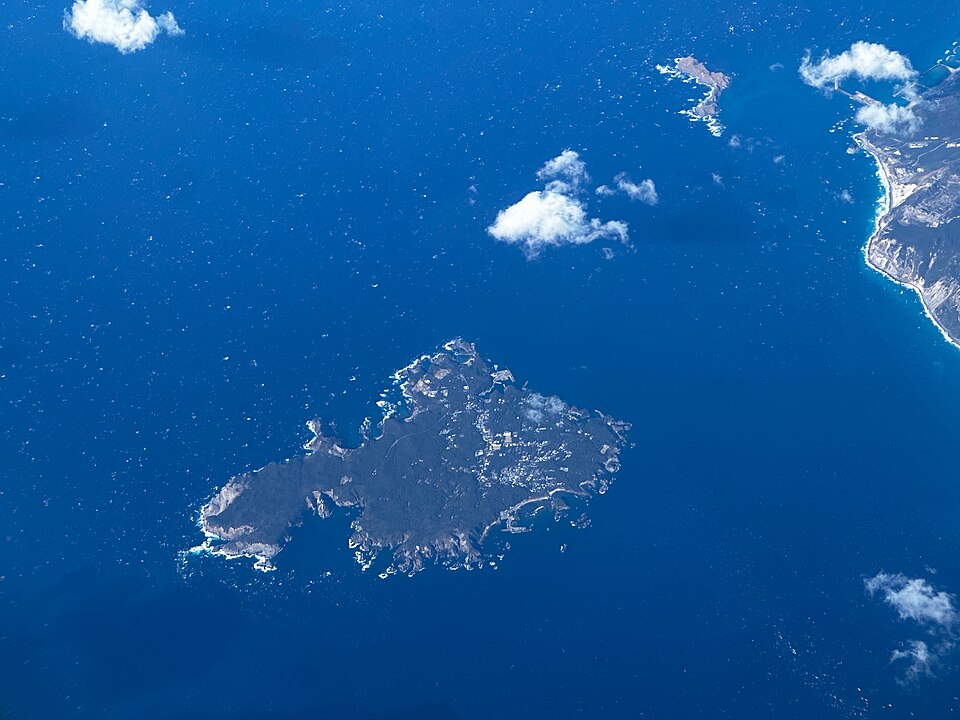
Shikine-jima from the air, 2023, Nested, Wikimedia Commons
5. Kozushima: Dolphins, Diving, and Clear Water
Distance from Tokyo: 180 km. Ferry time: approx. 3.5 hrs by jet ferry (summer); approx. 12 hrs by overnight large ship.
Kozushima’s main draw is its water. The visibility around the island is exceptional, and the combination of volcanic rock formations, coral, and warm Kuroshio Current water makes it one of the best diving and snorkeling destinations in the Tokyo island chain. The island is also a celebrated spot for swimming with wild dolphins: spinner and bottlenose dolphins are resident year-round, and licensed tour operators run guided water encounters that are among the most responsibly run in Japan. No chasing, no feeding, no disturbing natural behavior; the dolphins approach on their own terms, which means the encounters feel genuinely wild.
Maeyama, the island’s single prominent peak, offers a short hike to panoramic views of the surrounding sea. The beaches here are smaller and more sheltered than those on Niijima, making Kozushima a better choice for families with young children looking for calm water swimming.
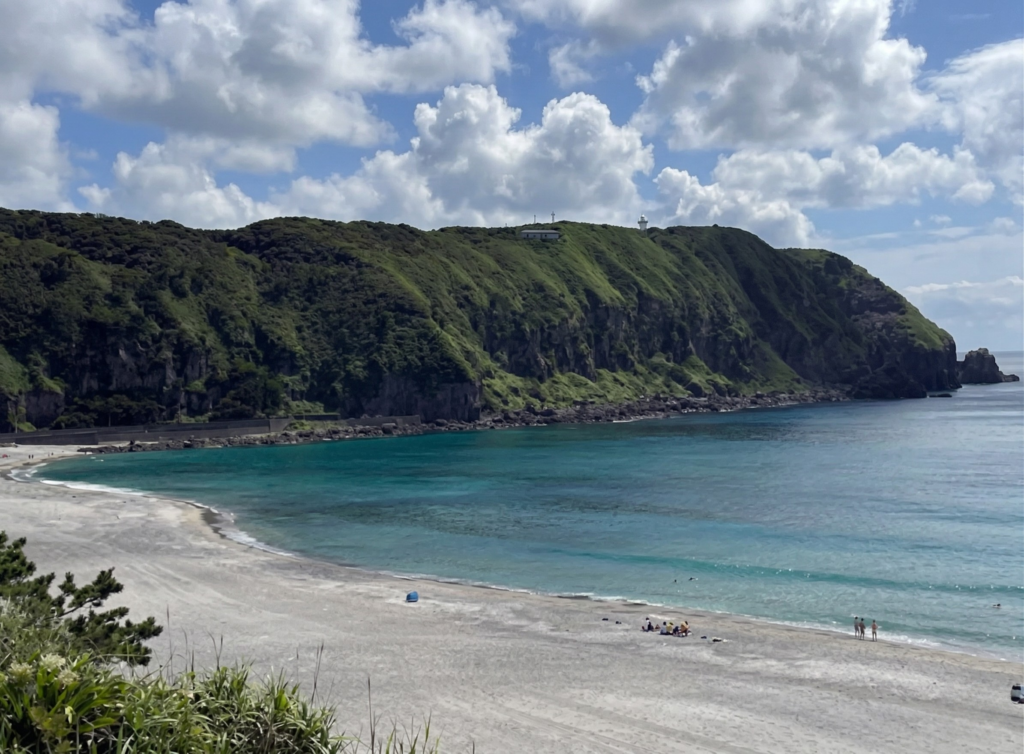
Maehama Beach, Kozushima
6. Miyakejima: An Island with a Long Volcanic History
Distance from Tokyo: 180 km. Ferry time: approx. 6.5 hrs by overnight large ship (arrives early morning).
Miyakejima is dominated by Mount Oyama, a 775-meter active volcano that last erupted catastrophically in 2000, forcing the entire island’s 3,500 residents to evacuate for nearly five years. They returned in 2005 to find their homes buried in ash and their forests transformed. The experience left an indelible mark on the island’s character, and today Miyakejima wears its volcanic history openly. Parts of the island’s interior remain closed due to toxic sulfur dioxide emissions from the crater, and visitors in affected areas are required to carry gas masks. This is not a detail: the masks are issued at the port, and the gas monitoring station readout is broadcast publicly. This is an active volcanic system, and the island makes no pretense otherwise.
What this history has produced is a landscape of uncanny beauty: lava forests, fumarolic vents, and coastal formations that have the raw, unsettled quality of a place that is still being made. Miyakejima is also an outstanding destination for bird watching, with endemic and migratory species including the Ijima’s leaf warbler, rare seabirds, and raptors riding the thermals above the crater. The island’s coral reefs and clear water make it a capable diving destination, and sea turtles feed on the reef walls year-round.
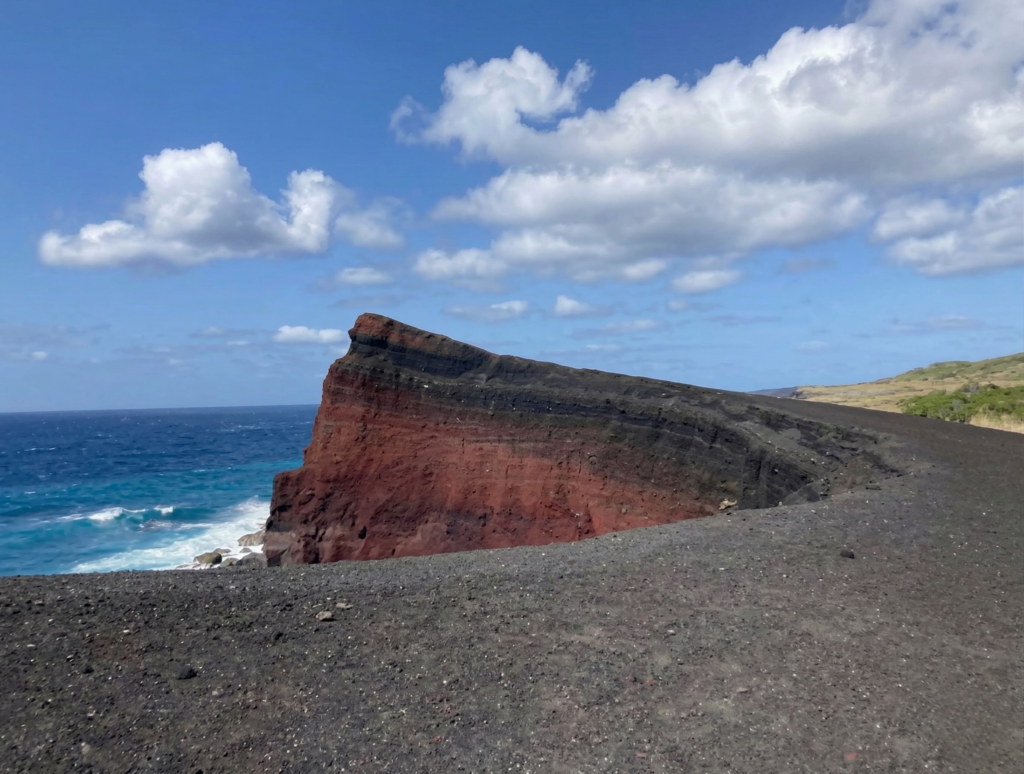
Nippana Shinzan, Miyakejima
7. Mikurajima: Swimming with Wild Dolphins
Distance from Tokyo: 200 km. Ferry time: approx. 8 hrs by overnight large ship.
Mikurajima is a small, thickly forested island with a permanent population of under 300. It has no airport and no jet ferry service. The only way in is the overnight ship, and visitor numbers are deliberately managed to protect the island’s extraordinary natural environment.
The reason to make the journey is dolphins. A resident pod of several hundred bottlenose dolphins lives year-round in the waters surrounding Mikurajima, and licensed tour operators offer snorkeling encounters from small boats. These are not performance dolphins: they are wild, free-ranging animals that have simply become accustomed to a respectful human presence in their territory. The encounters, when they happen, are among the most affecting wildlife experiences available in Japan. The island’s interior is a protected primeval forest with endemic bird species and walking trails. Accommodation is limited to a small number of minshuku; book well in advance. You cannot disembark from the ferry if you do not have a hotel booked in advance since accommodation is so limited!
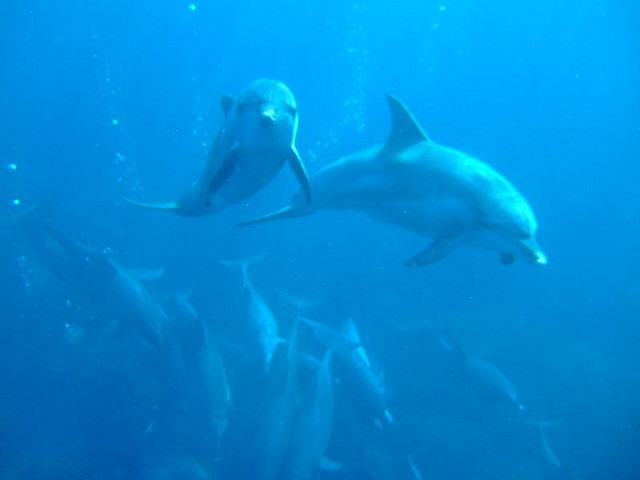
Indo-Pacific bottlenose dolphins of Mikurashima, Shinji, Wikimedia Commons
8. Hachijojima: The Subtropics Begin Here
Distance from Tokyo: 287 km. Ferry time: approx. 10.5 hrs by overnight large ship. Also reachable by ANA flight from Haneda Airport in approx. 55 minutes.
Hachijojima is the point at which the Tokyo islands stop feeling like an extension of the mainland and start feeling genuinely subtropical. The vegetation is lush and dense, the air is warmer and heavier, and the pace of life is measurably different. The island is shaped by two volcanoes: Hachijo-Fuji, a near-perfect cone that can be climbed to the rim in a few hours, and the older, more eroded Higashiyama to the south. Between them lies the main town of Kashitate, where most accommodation and restaurants are found.
Hachijojima has some of the best snorkeling and diving in the Izu chain, with warm Kuroshio Current water, high visibility, sea turtles, and manta rays seasonally. The island also has excellent geothermal hot springs (the Sokodo Onsen and Miharashi-no-Yu are particularly good), traditional yellow textile crafts called kihachijo, and a fascinating history as a site of political exile during the Edo period. The overnight ferry crossing that deposits you at the island at sunrise is itself memorable.
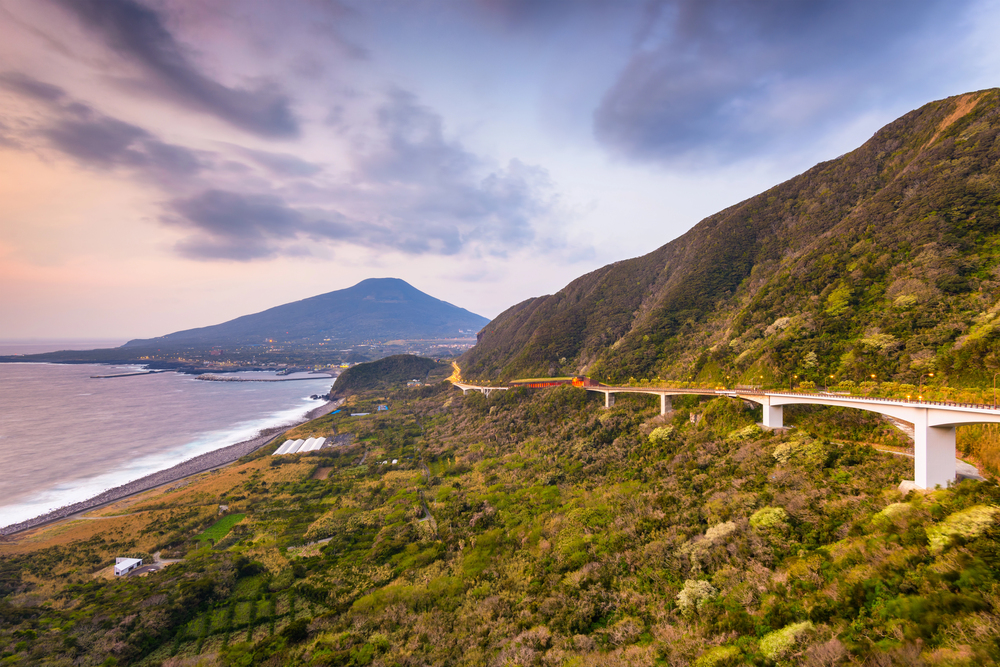
Hachijojima, Tokyo, Japan, DepositPhotos.com
9. Aogashima: The Most Spectacular Island You Have Never Heard Of
Distance from Tokyo: 358 km. Access: 2.5-hr ferry from Hachijojima (frequent cancellations), or 20-minute helicopter from Hachijojima (9 seats; book well in advance). Population: approximately 200 people.
Aogashima is the most remote, least visited, and most visually astonishing of all Tokyo’s islands. It is a classic caldera island: a large outer volcano with a smaller, newer volcano growing inside the crater at the center. You arrive (if the helicopter runs, and if the ferry is not cancelled, both of which are not guaranteed) to find yourself standing on the rim of an ancient outer caldera, looking down into a green bowl of jungle with a smoking volcanic cone at its center. There is no bank. There is one small restaurant, one small shop, and no traffic lights. The 200 or so permanent residents have constructed a small geothermal sauna, called Hirase Onsen, using volcanic heat venting directly from the inner caldera. You can also boil eggs in the ground. This is a working active volcanic system and a community of approximately 200 people who have chosen to live on top of it.
Aogashima requires commitment. The helicopter has 9 seats and books out weeks ahead. The ferry cancels more often than it runs. You may be stuck on the island longer than intended. Accommodation is a single small guesthouse; contact Aogashima Village Office for details. None of this is a reason not to go. It is the reason to go.
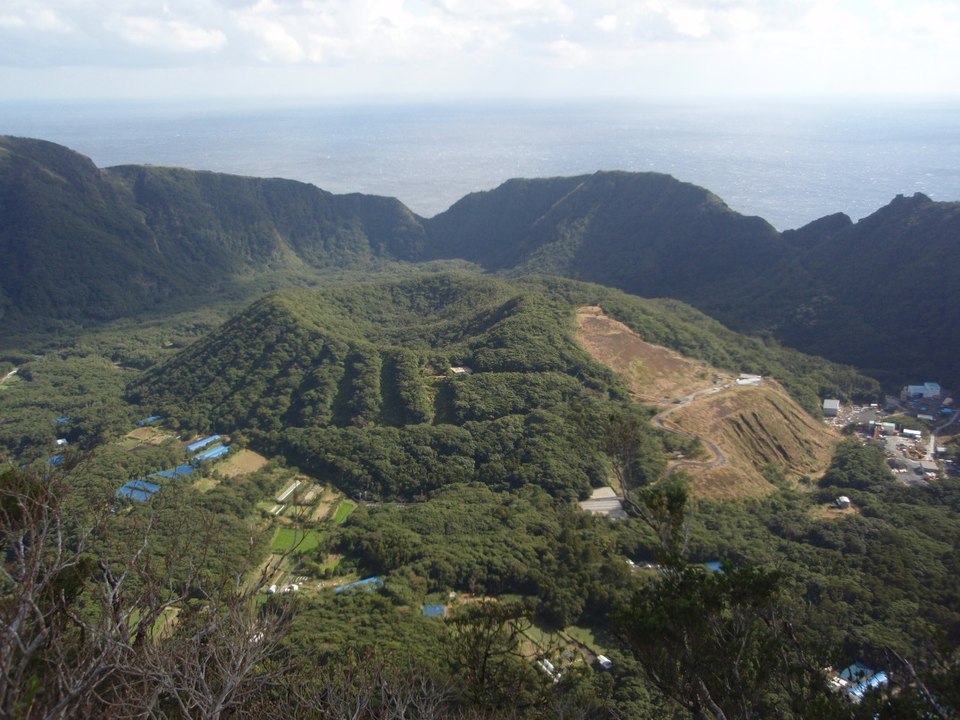
Maruyama close up, Aogashima, Public Domain
What Are the Ogasawara Islands, and Are They Worth the 24-Hour Ferry?
The Ogasawara Islands are in a different category from the Izu Islands. Located approximately 1,000 kilometers south of central Tokyo, they were designated a UNESCO Natural World Heritage Site in 2011 for their exceptional biodiversity. Because the islands were never connected to the Asian or North American continental landmasses, they evolved in almost complete isolation. The result is a concentration of endemic species found nowhere else on Earth: land snails, birds, plants, insects, and coral systems that exist only here. There is no airport. The only way in is the Ogasawara Maru, which takes 24 hours.
10. Chichijima: Father Island, Gateway to the Ogasawara Archipelago
Distance from Tokyo: 1,000 km. Ferry time: 24 hours aboard the Ogasawara Maru. Ferry frequency: roughly once a week (more in peak summer season). Minimum stay: 5 days (you must wait for the next scheduled departure to leave).
Chichijima (Father Island) is the largest and only significantly inhabited island of the Ogasawara group, and the point through which all visitors must pass. After the 24-hour crossing, the Ogasawara Maru docks at Futami Port, where the island’s entire community seems to turn out to greet arriving passengers. Island residents line the dock. Boats circle the ship. It feels like arriving somewhere that matters, and it does.
The beaches of Chichijima, particularly Kominato Beach and Minamijima Island (accessible only by guided boat tour), have coral reefs with extraordinary visibility and water temperatures warm enough for comfortable snorkeling throughout most of the year. The island’s forests contain endemic bird species including the Bonin White-Eye and the Bonin Islands honeyeater. Guided eco-tours are the standard way to explore the interior, and most accommodation providers offer guest pickup from the port. The small town around Futami Port has a disproportionate number of good restaurants given its size, most serving fresh local seafood.
The island also carries significant Pacific War history. The partially submerged wreck of the Hinko-maru, a transport ship torpedoed by an Allied submarine, lies in the shallow clear water of Sakaiura Beach and has become a snorkeling attraction that offers an unusual and sobering perspective on the island’s 20th-century past.
On the Ogasawara Maru: The ferry has six cabin classes, from private en-suite rooms to open economy tatami mat space. There is a cafeteria serving three meals a day, a lounge with an observation deck, a small shop, and a children’s room. Bring entertainment. Bring seasickness medication. Bring sunscreen: Ogasawara’s UV levels are approximately seven times those of mainland Tokyo. A tour of the bridge is held each morning. As the ship passes Hachijojima heading south, the water begins to change color.
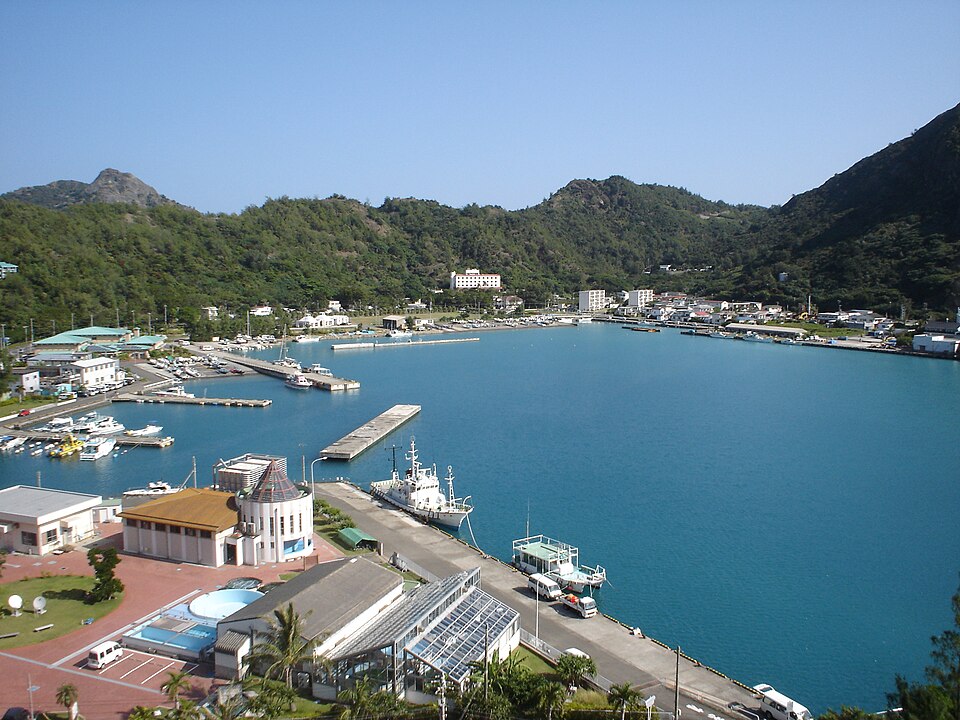
Futami Port, Chichijima. Right of center, at the edge of the port, is the settlement of Oku (or Okumura), site of the initial Oubeikei settlement, V5planet, Wikimedia Commons
11. Hahajima: Mother Island, Hiking, and Humpback Whales
Access: 2 hours by Hahajima Maru ferry from Chichijima. Tickets are sold on the day and cannot be reserved in advance. Population: approximately 450 people.
Where Chichijima is the Ogasawara Islands’ social hub, Hahajima (Mother Island) is their wilderness heart. The island is smaller, steeper, and wilder. Most of the island’s interior is protected forest accessible only with a licensed guide, and the dominant activity here is hiking: to the summit of Mount Chibusayama, the highest point in the entire Ogasawara archipelago, through forests of tree ferns and endemic Ogasawara palms, with views of the Pacific extending to the horizon in every direction.
The waters around Hahajima offer the best whale watching in the Ogasawara group. Humpback whales migrate through the surrounding sea from December through May and can frequently be observed breaching and singing close to the island. Sperm whales are present from May through November. Dolphin encounters are possible year-round. The snorkeling at Minamizaki Beach is outstanding, with warm clear water and healthy coral gardens. Hahajima has a small town near Oki Port with a handful of accommodation options, restaurants, and a single characterful cafe. It is a place for people who are genuinely prepared to be somewhere remote.
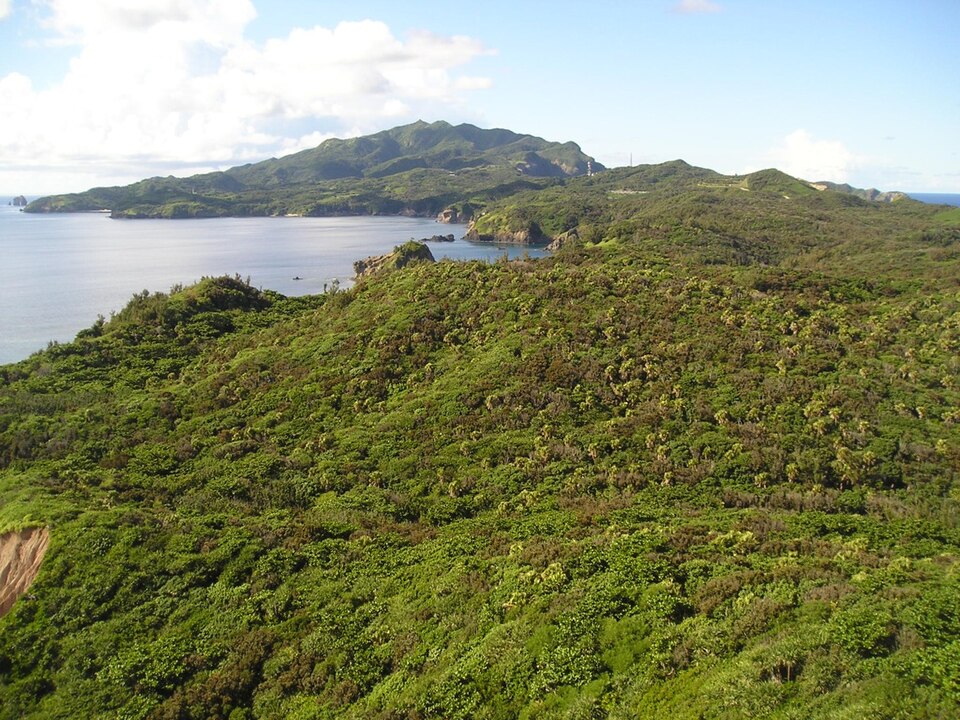
View of the southern tip of Hahajima, the Minamizaki peninsula, Si-take at Japanese Wikipedia, Wikimedia Commons
Are the Tokyo Islands Worth Visiting in 2026?
Without reservation. Tokyo’s island chain is one of the most varied and undervisited travel zones in Japan. You can reach an active volcano rim, a world-class surf beach, a Greek-style open-air onsen, and a dolphin encounter in the same archipelago, administered by the same metropolis you arrived in. The Ogasawara Islands are among the most pristine natural environments remaining in the entire Pacific region.
The island that will stay with you longest depends on what you are looking for. If you want surf, nightlife, and easy access: go to Niijima. If you want complete isolation and volcanic spectacle: go to Aogashima. If you want the most extraordinary wildlife destination in Japan, one with UNESCO status and 24-hour Pacific crossings: go to the Ogasawara Islands. None of them will disappoint.
If you want beaches, onsen, volcanoes, dolphins, and a Japan you have never seen before, all accessible by ferry from central Tokyo, these islands are not optional. They are essential.
Frequently Asked Questions: Tokyo’s Islands
What islands are close to Tokyo?
Tokyo has 11 inhabited islands: the 9 Izu Islands (Oshima, Toshima, Niijima, Shikinejima, Kozushima, Miyakejima, Mikurajima, Hachijojima, and Aogashima) and the 2 inhabited Ogasawara Islands (Chichijima and Hahajima). The closest, Izu Oshima, is reachable by jet ferry from central Tokyo in approximately 1 hour 45 minutes. The most remote, Chichijima in the Ogasawara Islands, takes 24 hours by ferry.
How do I get to the Izu Islands from Tokyo?
Ferries to the Izu Islands are operated by Tokai Kisen and depart from Takeshiba Passenger Terminal, a 10-minute walk from JR Hamamatsucho Station or a 1-minute walk from Yurikamome Takeshiba Station. High-speed jet ferries serve Oshima, Toshima, Niijima, Shikinejima, and Kozushima, primarily during summer. Overnight large passenger ships serve all islands including Miyakejima, Mikurajima, and Hachijojima, departing around 22:30. Book tickets at tokaikisen.co.jp.
How do I get to the Ogasawara Islands from Tokyo?
The only way to reach the Ogasawara Islands (Chichijima and Hahajima) is by the Ogasawara Maru ferry, operated by Ogasawara Kaiun. The ferry departs from Takeshiba Pier in central Tokyo and takes 24 hours to reach Futami Port on Chichijima Island. It departs roughly once a week during most of the year, with more frequent sailings during peak summer season. There is no airport on either island. Book at ogasawarakaiun.co.jp.
What is the best Tokyo island for surfing?
Niijima is the best Tokyo island for surfing. Habushiura Beach on Niijima’s east coast is Japan’s premier surf destination, with a 4-kilometer stretch of fine white sand, consistent Pacific swell, and waves year-round. The island is reachable by jet ferry from Tokyo in approximately 2.5 to 3.5 hours during summer, or by overnight large passenger ship in approximately 10.5 hours.
What is the Greek temple onsen on Niijima?
The Yunohama Roten Onsen on Niijima Island is a free, open-air hot spring bath on a clifftop overlooking the port, approximately 10 minutes on foot from Niijima Port. It is built from kogaseki, a white rhyolite stone found only on Niijima and on Lipari Island in Italy, and its columns, arches, and stone basins are designed with ancient Greek architectural motifs. Six baths of varying sizes hold up to 80 people and are open 24 hours a day, free of charge. It is best visited at sunset or at night under a clear sky.
Can you swim with dolphins near Tokyo?
Yes. Kozushima and Mikurajima, both part of the Izu Islands administered by Tokyo, offer licensed wild dolphin swimming experiences. Resident pods of bottlenose and spinner dolphins live year-round in the waters around both islands. Encounters are conducted by licensed operators on small boats and are not guaranteed, as the dolphins approach on their own terms. Mikurajima is particularly well regarded for the quality of its dolphin encounters. Both islands require an overnight trip from Tokyo by large passenger ship.
Are the Ogasawara Islands a UNESCO World Heritage Site?
Yes. The Ogasawara Islands, including Chichijima and Hahajima, were inscribed as a UNESCO Natural World Heritage Site in 2011. The designation recognized the islands’ exceptional biodiversity, including numerous species of birds, land snails, plants, and insects found nowhere else on Earth. Because the islands were never connected to any continental landmass, their ecosystems evolved in near-complete isolation. Camping and off-trail hiking are strictly prohibited to protect the environment.
What is the most remote island near Tokyo?
Aogashima is the most remote of Tokyo’s Izu Islands, located 358 kilometers south of Tokyo with a permanent population of approximately 200 people. It is a dramatic double-caldera island, with a smaller active volcano growing inside the crater of a larger outer caldera. Access is by a 2.5-hour ferry from Hachijojima (which cancels frequently) or a 20-minute helicopter that holds only 9 passengers. The Ogasawara Islands (Chichijima and Hahajima) are even further, at approximately 1,000 kilometers from Tokyo, reachable only by a 24-hour ferry crossing.
When is the best time to visit the Tokyo islands?
The best time to visit the Izu Islands (Oshima, Niijima, Hachijojima, etc.) is from late June through September, when jet ferry services are at their most frequent, water temperatures are warmest for swimming and snorkeling, and the islands are at their most lush. July and August are peak season; expect more visitors and book ferries well in advance. The Ogasawara Islands (Chichijima, Hahajima) can be visited year-round, with whale watching at its best from December through May. Camellia season on Oshima and Toshima runs from January through March.
Which Tokyo islands can I visit as a day trip from Tokyo?
Izu Oshima is the only Tokyo island realistically doable as a day trip from Tokyo. The jet ferry from Takeshiba Terminal takes approximately 1 hour 45 minutes each way, leaving enough time to hike the Mount Mihara volcano rim, visit the lava desert, and soak in a geothermal onsen before the return crossing. For a weekend trip from Tokyo, Niijima and Shikinejima are the best choices, offering surf beaches, free outdoor onsen, and a relaxed two to three night itinerary. Hachijojima is also popular for a long weekend and is reachable by ANA flight from Haneda in approximately 55 minutes as an alternative to the overnight ferry.
Are the Tokyo islands worth visiting in 2026?
Yes. Tokyo’s islands are among the most varied and undervisited travel destinations in Japan. They offer active volcanoes, world-class surf beaches, wild dolphin and whale encounters, geothermal hot springs, and the UNESCO World Heritage ecosystems of the Ogasawara Islands. All are accessible by ferry from central Tokyo. The closest island, Izu Oshima, is reachable in under two hours. The Ogasawara Islands, among the most pristine natural environments in the Pacific, are a once-in-a-lifetime destination for anyone who makes the 24-hour crossing.




0 Comments