
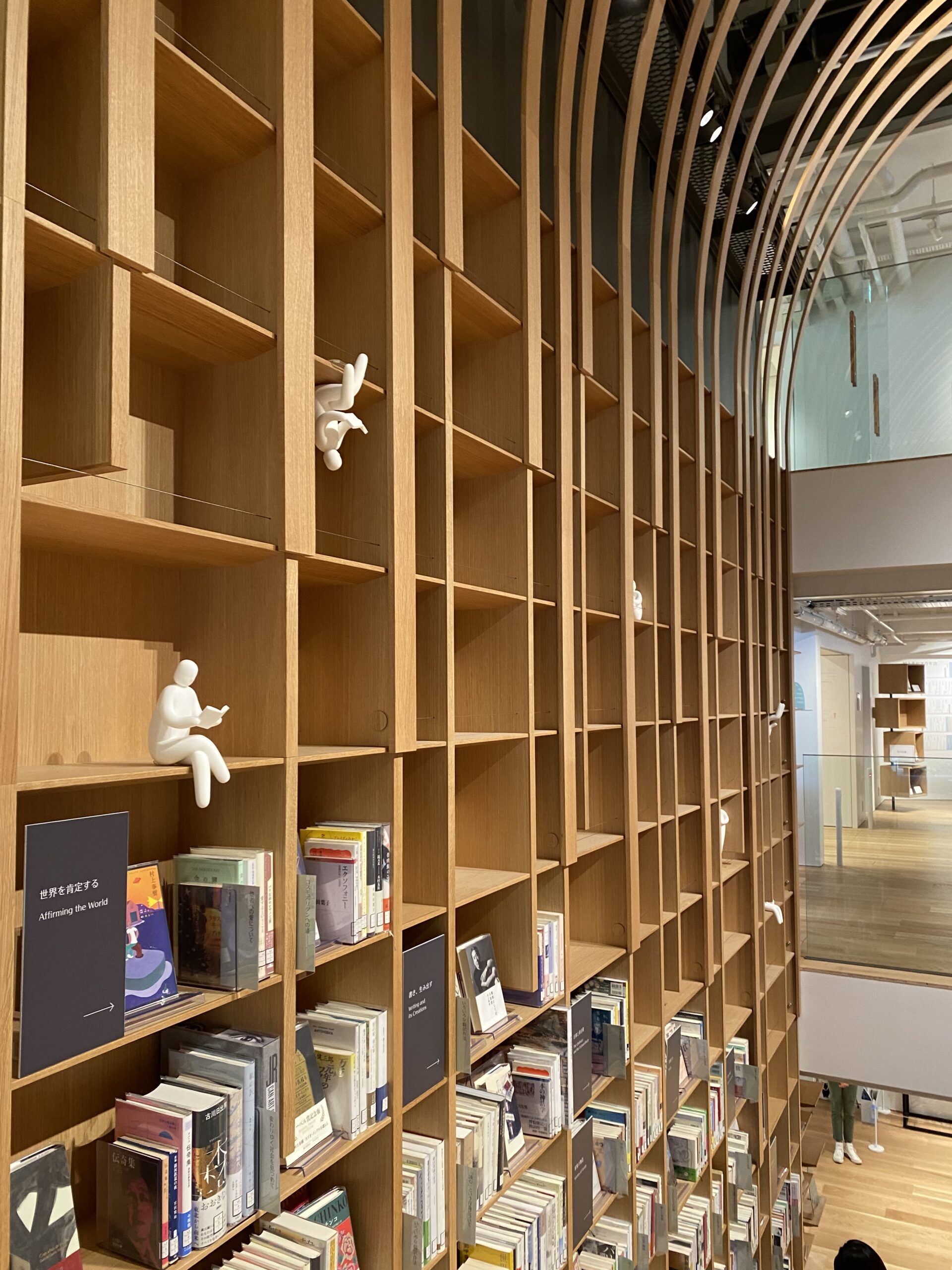
The Waseda International House of Literature, known the world over as the Haruki Murakami Library, is one of the most enchanting places in Tokyo for book lovers and architecture fans alike. Here is everything you need to know before you go.
By Tokyo Becky
Official name: The Waseda International House of Literature (The Haruki Murakami Library)
Location: Waseda University campus, 1-6-4 Nishiwaseda, Shinjuku-ku, Tokyo, Japan
Admission: Free
Opening hours: 10:00 to 5:00 pm, Thursday through Tuesday. Closed on Wednesdays and other designated days. Check the calendar at waseda.jp/culture/wihl before visiting.
Reservations: Groups of up to 20 people can visit without a reservation. Groups of 21 or more must reserve in advance via the library website.
Session length: 90 minutes per visit
How to get there: From Shinjuku Station, take the Yamanote Line to Takadanobaba Station, transfer to the Tozai Line, ride one stop to Waseda Station, and walk approximately 8 to 10 minutes through the campus. Navigate to the library via Google or Apple Maps, and you will find it!
Architect: Kengo Kuma
Opened: October 1, 2021
Photography: Permitted. Videos and close-up photography of books are not permitted.
Who Is Haruki Murakami?
If you have never heard of Haruki Murakami, first of all, where have you been? He is truly one of the most prolific authors of all time. Murakami was born in Kyoto in 1949 and raised in Hyogo Prefecture before moving to Tokyo to study drama at Waseda University, the same campus that now houses his library. He did not begin writing fiction until the age of 29, and he describes the moment his first novel came to him as arriving suddenly, like a revelation, while watching a baseball game. He went home and wrote through the night. That novel, Hear the Wind Sing, won a Japanese literary prize and launched one of the most internationally celebrated careers in modern literature.
Before becoming a full-time writer, Murakami and his wife Yoko ran a Tokyo jazz bar called Peter Cat for seven years. His deep love of jazz and Western music, from classical to rock, runs through virtually everything he has written. His novels are populated with vinyl records and jazz clubs, with characters who listen to music the way other people breathe.
He has since written 14 novels, dozens of short story collections, and over 40 works of nonfiction, as well as translating more than 70 books from English into Japanese. His work has been published in more than 50 languages. He is, in short, one of the most widely read living writers on the planet. And yet for decades, he remained notoriously private, rarely giving interviews and never giving public readings. In March 2024, he broke from that tradition in a remarkable way: he read publicly to more than a thousand people at the very library that bears his name, raising funds for its collection.
Having decided not to have children, Murakami approached Waseda University with a proposal: he would donate thousands of books, vinyl records, manuscripts, letters, and archival materials, on the condition that they built a place worthy of housing them. He wanted something alive. A space for conversation, creative exchange, and discovery, not a quiet shrine where people would only want to visit once.
The result, designed by acclaimed Japanese architect Kengo Kuma and opened in October 2021, is one of the most beautiful and unusual cultural spaces in Tokyo.

Haruki Murakami in 2018, Ministerio Cultura y Patrimonio from Quito, Ecuador, Wikimedia Commons
What Are Murakami’s Best Books to Read Before You Visit?
You do not need to have read Murakami before visiting the library. However, if you have the time, reading even one of his novels before you go will make the experience feel much more personal. Here are three of his finest works along with a taste of his voice.
Norwegian Wood (1987)
This is the book that made Murakami a household name in Japan and a phenomenon worldwide. Set in late 1960s Tokyo, it is a quiet, devastating story about love, loss, and the complicated process of growing up. When it was published in Japan, three million copies sold almost immediately. Young people saw themselves in it, and it remains the most direct and emotionally accessible entry point into his work.
The book’s Tokyo is recognizable but haunted, a city that holds grief the way an old piece of wood holds rain.
Hard-Boiled Wonderland and the End of the World (1985)
Two parallel narratives, two different worlds, one of them a near-future cyberpunk Tokyo, the other a timeless walled city where unicorns roam and the protagonist reads dreams from the skulls of unicorns. The novel alternates between them chapter by chapter, and at some point, impossibly, they begin to converge. It is the book that best showcases Murakami’s genius for sustaining two registers at once: the wryly mundane and the achingly strange.
1Q84 (2009 to 2010)
This is Murakami’s most ambitious work and my personal favorite because it so expertly took me back to my time living right next to the highway where it all begins in Tokyo. It is a sprawling, 1,000-page masterpiece set in an alternate version of 1984 Tokyo where two moons hang in the sky and reality has quietly, terrifyingly slipped. It follows two protagonists across three volumes, a fitness instructor and an aspiring novelist, whose lives are moving toward each other along invisible parallel tracks. It is the kind of novel that you disappear into for days and emerge from blinking, not entirely sure which world you belong to.
I had a crazy experience related to 1Q84 in 2024. I was sitting in the audience at a tech conference in Lisbon, Portugal, and the man on stage said “Have you ever been reading a book that you didn’t want to end because you were so absorbed it its world?” I immediately thought of 1Q84. The next sentence I heard from the speaker after he paused for us to think was “For me, it’s 1Q84 by Haruki Murakami.” I gasped because I felt like I had just had a mind meld with the speaker unbeknownst to him. You may join us in our feelings about this book after you read it.
Do You Need to Make a Reservation to Visit the Haruki Murakami Library?
This is the most important practical question, and the answer has changed since the library first opened.
When the Haruki Murakami Library first welcomed visitors in October 2021, timed entry slots of 90 minutes were required for everyone, bookable in advance on the Waseda University website. As of the most recent update to the library’s visitor policy, groups of up to 20 people can now visit without a reservation during regular opening hours. Groups of 21 or more must still contact the library by email in advance to arrange their visit.
The library is open from 10:00 to 5:00 pm, Thursday through Tuesday, and is closed on Wednesdays as well as during Waseda University entrance examination periods (typically February 1 to March 1) and other designated days. Hours are subject to change during university events such as Open Campus and the Waseda Festival.
Before any visit, I strongly recommend checking the official calendar at waseda.jp/culture/wihl/en/facility/visit. The calendar is updated regularly and will show any closures or schedule changes for the weeks ahead.
The Research Collection Stacks on the third floor have their own separate opening hours: Mondays, Tuesdays, and Fridays from 13:00 to 17:00. If accessing the research archive is part of your plans, plan your visit on one of those days.
Photography is permitted throughout most of the building. Videos and close-up photography of individual book pages are not permitted. No parking is available on campus, so plan to arrive by public transit.
How Do I Get to the Haruki Murakami Library?
The library sits on the main campus of Waseda University in Shinjuku, Tokyo. The most straightforward route from central Tokyo is as follows:
| Departing From | Route | Approx. Time |
|---|---|---|
| Shinjuku Station | Yamanote Line to Takadanobaba, transfer to Tozai Line (1 stop to Waseda Station), then walk approx. 8 minutes | Approx. 20 minutes |
| Tokyo Station (Otemachi) | Tozai Line direct from Otemachi Station (5 min on foot from Tokyo Station) to Waseda Station (approx. 10 minutes, 170 yen), then walk approx. 10 minutes | Approx. 25 minutes |
| Shibuya Station | Fukutoshin Line to Nishi-Waseda Station (approx. 10 minutes), then walk approx. 7 minutes to campus | Approx. 20 minutes |
No parking is available at Waseda University. Please use public transportation.
Once you reach the campus, follow signs for Building 4 or the Haruki Murakami Library. The exterior of the building is distinctive: Kengo Kuma wrapped the existing university structure in a curving wooden tunnel that arches dramatically over the entrance, painted white, with flowing lines that draw you toward the door. You will recognize it immediately.
If you plan to visit only the basement cafe, there is a separate entrance on the B1 floor that you can use directly without entering through the main library entrance upstairs.
While you are in the area, the Tsubouchi Memorial Theatre Museum is directly adjacent to the library and is well worth a short detour. Murakami frequented it as a student to read film screenplays, and it is one of the hidden gems of the Waseda campus.


What Can You See and Do Inside the Haruki Murakami Library?
I got to visit the Haruki Murakami Library in 2022, and I want to be honest with you: I was not prepared for how beautiful it was going to be. I had expected something pleasant. I had not expected something magical. The building has three floors open to the public, plus a basement level, and each space feels like a different chapter of the same extraordinary book.
I cannot wait to go back, especially because when I went, I had to book in advance and there were timed entries and exits.
The Atrium Staircase
The moment you step inside, you are confronted with the building’s centerpiece: a soaring open atrium that is also a staircase descending to the basement level. On either side, bookshelves rise to extraordinary heights, the shelving slats curving inward as they reach the ceiling, meeting like the ribs of a wooden ship turned upside down. Kengo Kuma’s design team described the space as a tunnel between dimensions, and the description is apt. The curved wood lines are intended to reflect what Murakami himself calls the “kindness” of his own writing. Standing at the top of that staircase on my first visit, I felt it immediately. It is warm here in a way that glass and steel can never quite manage.

The Gallery (First Floor)
The first-floor gallery holds approximately 1,400 editions of Murakami’s novels, arranged chronologically from 1979 to the present, many of them first editions. Alongside the books you will find a set of original chairs from Peter Cat, the jazz bar Murakami ran with his wife in Kokubunji before his writing career began. The sight of those chairs alongside those early novels says something about creative lives and the strange, winding roads they travel. The gallery also holds Murakami’s books translated into more than 50 languages, arranged on shelves so that you can see just how far his imagination has traveled. There are editions here that you would never find anywhere else in the world.
The Audio Room (First Floor)
Next to the gallery is the audio room, and this is where you feel the full weight of Murakami’s other great love: music. Murakami has collected over 20,000 vinyl records across his lifetime. A curated selection plays continuously through a Luxman turntable and state-of-the-art speakers. The room itself is fitted with sleek mid-century furniture that would not look out of place in a scene from Norwegian Wood. Many of the records still bear the original seal of Peter Cat. Sitting in that room, listening to jazz fill the air the same way it would have filled his bar fifty years ago, you understand something about how he writes that no interview has ever quite captured.
On the second floor, you can also sit and listen to records in a public listening room equipped with an audio system that visitors can use themselves. If you have the time, plan to spend a full 90 minutes here. It does not feel like enough.

The Reading Room (First Floor)
Opposite the audio room is a quiet reading room with shelves loosely organized by topic and a long communal work table where visitors can sit and read. The books here are drawn from the library’s collection of approximately 3,000 texts, including translated novels, first editions, and works personally donated by Murakami himself. You can also search the full collection using the library’s WINE search terminal, which connects to Waseda University’s library database.
The Exhibition Room and Studio (Second Floor)
The second floor hosts a rotating programme of literary and cultural exhibitions curated by the Waseda International House of Literature team. Past exhibitions have explored the relationship between jazz and literature, the translation of Japanese fiction into English, and Murakami’s relationship with Kafka. The studio space on this floor is used for events, readings, and workshops, including the ongoing “Authors Alive” series, where writers share their work with a live audience. On rare and wonderful occasions, Murakami himself has appeared. Check the event calendar on the library website before your visit.

Murakami’s Study and the Vinyl Archive (Basement Level)
Descend the atrium staircase and you reach the basement level, where the library holds a replica installation of Murakami’s current study, the room where he actually sits and writes. It is not always open to direct entry, but you can look in from outside through a glass partition. Seeing it felt oddly intimate, the way reading someone’s diary feels intimate, except that Murakami agreed to including this recreation. It’s always interesting to see the places where we can imagine a writer creating some of their most famous stories.

The Orange Cat Cafe (Basement Level)
The basement also houses the Orange Cat cafe, named for the orange tabby cats that appear in several Murakami novels. The menu is inspired by his work and his interests, and the space also holds a piano from Peter Cat, the original jazz bar. Alongside the books and records displayed nearby, the piano is one of the most quietly poignant objects in the building. If you want to visit only the cafe, you can enter directly from the B1 entrance without going through the main library. The cafe also sells library merchandise, including tote bags and bookmarks, which make for some of the best literary souvenirs in Tokyo.
The Research Collection Stacks (Third Floor)
The third floor is home to the Research Collection Stacks, open to the public on Mondays, Tuesdays, and Fridays from 1:00 pm to 5:00 pm. This is where the library’s archival holdings are stored, including unpublished manuscripts, correspondence, interview materials, and book reviews, many of them donated directly by Murakami. Access to this floor requires visiting on one of its designated open days, but for a serious reader or researcher, it is worth building your trip around.
What Else Should I Know Before Visiting the Haruki Murakami Library?
How long do you need? It depends how big of a Murakami fan you are, but I would allow at least 90 minutes to two hours, especially if you end up grabbing a coffee at the café or listening to one of the jazz records.
Is the library good for people who have not read Murakami? Absolutely. The architecture alone is worth the visit, and the audio room and gallery are enjoyable without any prior knowledge of his work. That said, reading even 50 pages of any Murakami novel before you go will deepen the experience considerably.
Is the library accessible? The campus of Waseda University has accessible routes, and the library building itself was designed for general public access. Contact the library directly at their official website if you have specific accessibility requirements.
Are there staff guides? Yes. The library provides staff guides who can help visitors navigate the facility and make use of the collection. They can assist with the WINE search terminal and point you toward specific areas of interest.
Is it worth combining with other Shinjuku-area sights? Very much so. Waseda is a short train ride from Shinjuku itself, which means you can pair a morning at the library with an afternoon in one of Tokyo’s most dynamic neighborhoods. If you have not yet been to Golden Gai, Shinjuku’s extraordinary cluster of more than 200 tiny bars tucked inside two-story postwar buildings, an evening there after the library makes for one of the most perfectly Japanese days imaginable: a morning immersed in literature and jazz, an evening immersed in the city that inspired so much of it. If you want to end the evening with a long, steaming soak, Thermae-Yu, Tokyo’s largest hot spring, is just a few steps from Golden Gai and open 24 hours.
For first-time visitors to the city, my full guide to the top five things to do in Tokyo is a good starting point for building an itinerary around the library visit. If you want to discover the side of Tokyo that most visitors miss entirely, the neighborhood of Shimokitazawa, with its independent bookshops, jazz bars, and second-hand record stores, feels like it was made for Murakami readers. Jimbōchō, which is known as the center of Tokyo’s used bookstores and publishing houses, may also be an interesting place to visit for book lovers like Murakami.
Is the Haruki Murakami Library Worth Visiting?
Without hesitation: yes. The Haruki Murakami Library is one of the most beautiful and thoughtfully conceived cultural spaces I have visited anywhere in the world. It is free. It is welcoming. It is full of music, books, inspiring architecture, and, of course, Murakami magic.
What struck me most during my 2022 visit was not the architecture, as extraordinary as it is, and not the first editions or the archival treasures, but the feeling the building creates: a sense that literature is not something finished and distant, stored under glass, but something alive. Something that keeps asking questions. Murakami wanted a place that people would want to come back to, and that is certainly how I still feel today.
If you love books, architecture, jazz, or any combination of the three, the Haruki Murakami Library is not optional. It is essential.



0 Comments